Textbook Question
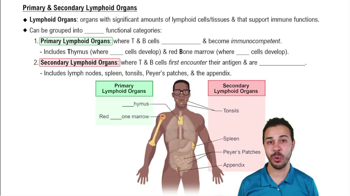
Collections of lymphoid tissue (MALT) that guard mucosal surfaces include all of the following except:
a. Appendix follicles
b. The tonsils
c. Peyer's patches
d. The thymus
12
views

 Hoehn, Haynes, Abbott 12th EditionCh. 20 The Lymphatic System and Lymphoid Organs and TissuesProblem 8
 Verified step by step guidance
 4:48
4:48
 4:34
4:34 2:07
2:07Collections of lymphoid tissue (MALT) that guard mucosal surfaces include all of the following except:
a. Appendix follicles
b. The tonsils
c. Peyer's patches
d. The thymus
Compare the structure and functions of a lymph node to those of the spleen.
The germinal centers in lymph nodes are largely sites of:
a. Macrophages
b. Proliferating B lymphocytes
c. T lymphocytes
d. All of these
Compare and contrast blood, interstitial fluid, and lymph.
Lymph nodes are densely clustered in all of the following body areas except:
a. Brain
b. The axillae
c. The groin
d. The cervical region
The red pulp areas of the spleen are sites of:
a. Splenic sinusoids, macrophages, and red blood cells
b. Clustered lymphocytes
c. Connective tissue septa