

Ch. 2 Chemistry Comes Alive
Hoehn - Marieb Human Anatomy & Physiology, 12th edition
Hoehn, Haynes, Abbott12th EditionMarieb Human Anatomy & PhysiologyISBN: 9780138242732Not the one you use?Change textbook
Chapter 2, Problem 26

Jason, a 12-year-old boy, was awakened suddenly by a loud crash. As he sat up in bed, straining to listen, his fright was revealed by his rapid breathing (hyperventilation), a breathing pattern effective in ridding the blood of CO₂. At this point, was his blood pH rising or falling?

Verified step by step guidance
1
Step 1: Understand the relationship between CO₂ and blood pH. Carbon dioxide (CO₂) in the blood combines with water to form carbonic acid, which dissociates into hydrogen ions (H⁺) and bicarbonate (HCO₃⁻). The reaction is: \[\mathrm{CO_2 + H_2O \leftrightarrow H_2CO_3 \leftrightarrow H^+ + HCO_3^-}\] More CO₂ means more H⁺ ions, which lowers pH (making blood more acidic).
Step 2: Recognize that hyperventilation causes rapid breathing, which expels CO₂ from the lungs faster than it is produced. This decreases the partial pressure of CO₂ in the blood (hypocapnia).
Step 3: With less CO₂ in the blood, the equilibrium shifts to reduce hydrogen ion concentration, leading to a decrease in acidity and thus an increase in blood pH (making it more alkaline).
Step 4: Conclude that during hyperventilation, because CO₂ is being removed quickly, the blood pH is rising (becoming more basic).
Step 5: Summarize that Jason’s rapid breathing is causing respiratory alkalosis, a condition where blood pH increases due to excessive loss of CO₂.

Verified video answer for a similar problem:

This video solution was recommended by our tutors as helpful for the problem above.
Video duration:
4m
Was this helpful?

Key Concepts

Here are the essential concepts you must grasp in order to answer the question correctly.

Hyperventilation and CO₂ Levels

Hyperventilation is rapid or deep breathing that causes excessive expulsion of carbon dioxide (CO₂) from the blood. This reduction in CO₂ decreases the amount of carbonic acid in the blood, which directly affects blood pH.
Recommended video:
Guided course
05:04
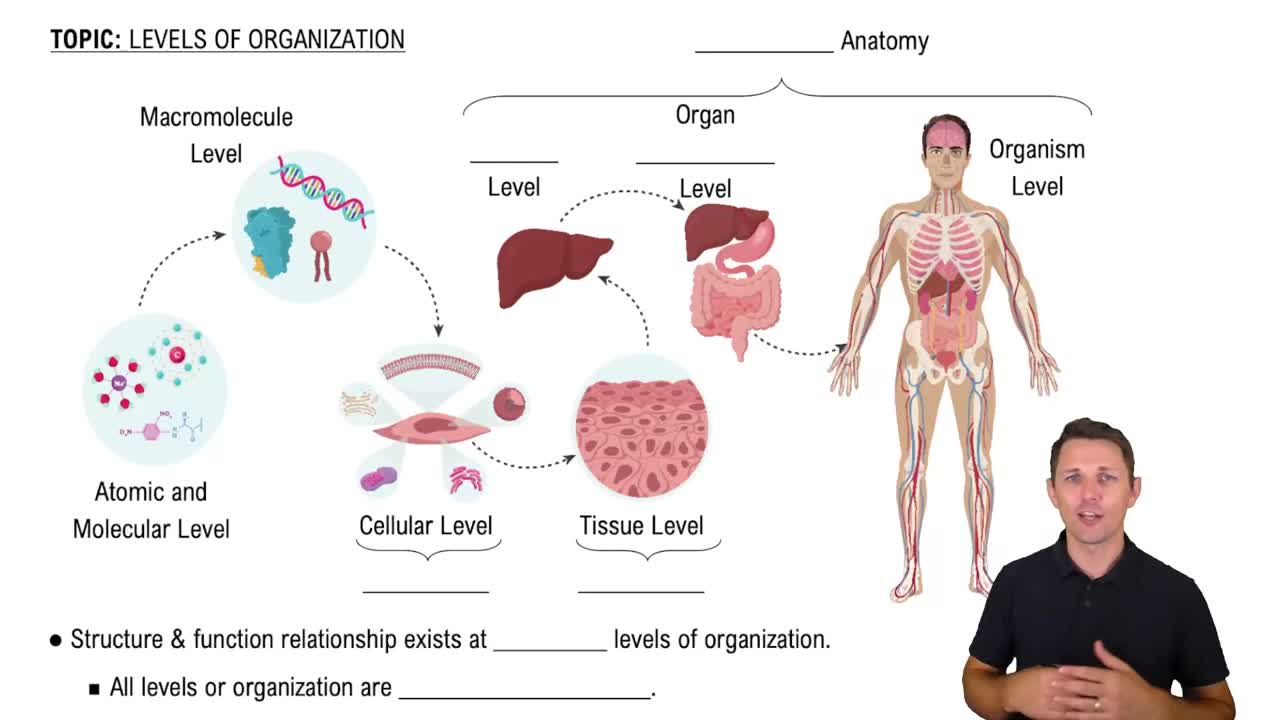
The Levels of Organization

Blood pH and Acid-Base Balance

Blood pH measures how acidic or basic the blood is, normally around 7.4. A decrease in CO₂ leads to less carbonic acid, causing the blood to become more alkaline, thus raising the pH (respiratory alkalosis). Conversely, increased CO₂ lowers pH (acidosis).
Recommended video:
01:29
Acids and Bases

Respiratory Regulation of Blood pH

The respiratory system helps regulate blood pH by controlling CO₂ levels through breathing rate. When CO₂ is expelled faster than produced, as in hyperventilation, blood pH rises. This is a key mechanism in maintaining acid-base homeostasis.
Recommended video:
07:58
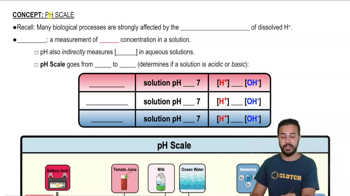
pH Scale