Textbook Question
The myocardium receives its blood supply directly from the:
a. Aorta
b. Coronary arteries
c. Coronary sinus
d. Pulmonary arteries
1
views
 Hoehn, Haynes, Abbott 12th EditionCh. 19 The Cardiovascular System: Blood VesselsProblem 12
 Verified step by step guidance
 3:20
3:20
 1:28
1:28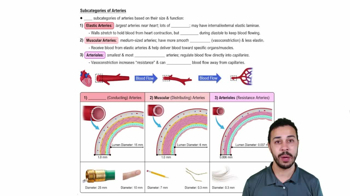 14:43
14:43The myocardium receives its blood supply directly from the:
a. Aorta
b. Coronary arteries
c. Coronary sinus
d. Pulmonary arteries
Blood flow in the capillaries is steady despite the rhythmic pumping of the heart because of the:
a. Elasticity of the large arteries
b. Small diameter of capillaries
c. Thin walls of the veins
d. Venous valves
How is the anatomy of capillaries and capillary beds well suited to their function?
Using the letters from column B, match the artery descriptions in column A. (Note that some require more than a single choice.)
Column A
____ (1) unpaired branch of abdominal aorta
____ (2) second branch of aortic arch
____ 3) branch of internal carotid
____ (4) branch of external carotid
____ (5) origin of femoral arteries
Column B
a. right common carotid
b. superior mesenteric
c. left common carotid
d. external iliac
e. inferior mesenteric
f. superficial temporal
g. celiac trunk
h. facial
i. ophthalmic
j. internal iliac
a. Define blood pressure. Differentiate between systolic and diastolic blood pressure.
b. What is the normal blood pressure value for an adult?
Describe the neural mechanisms responsible for controlling blood pressure.