Ch. 14 The Autonomic Nervous System
Hoehn - Marieb Human Anatomy & Physiology, 12th edition
Hoehn, Haynes, Abbott12th EditionMarieb Human Anatomy & PhysiologyISBN: 9780138242732Not the one you use?Change textbook
Chapter 14, Problem 7

Briefly explain why the following terms are sometimes used to refer to the autonomic nervous system: involuntary nervous system and emotional-visceral system.

Verified step by step guidance
1
Step 1: Understand that the autonomic nervous system (ANS) controls bodily functions that are not consciously directed, such as heart rate, digestion, and respiratory rate.
Step 2: Recognize that the term 'involuntary nervous system' is used because the ANS operates automatically without conscious control, managing essential physiological processes.
Step 3: Note that the term 'emotional-visceral system' highlights the ANS's role in linking emotional states to visceral (internal organ) responses, such as changes in heart rate or digestion during stress or relaxation.
Step 4: Connect these terms by explaining that the ANS integrates emotional experiences with physical reactions, which is why it is sometimes described as the emotional-visceral system.
Step 5: Summarize that both terms emphasize different aspects of the ANS: 'involuntary' focuses on its automatic control, while 'emotional-visceral' emphasizes its role in emotional and internal organ regulation.

Verified video answer for a similar problem:

This video solution was recommended by our tutors as helpful for the problem above.
Video duration:
2m
Was this helpful?

Key Concepts

Here are the essential concepts you must grasp in order to answer the question correctly.

Autonomic Nervous System (ANS)

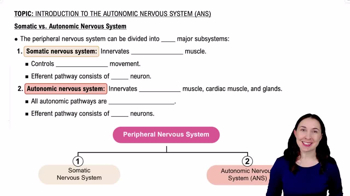
The ANS is a part of the peripheral nervous system that controls involuntary bodily functions such as heart rate, digestion, and respiratory rate. It operates without conscious control, regulating internal organs to maintain homeostasis.
Recommended video:
1:50
Somatic vs. Autonomic Nervous System

Involuntary Nervous System

This term highlights the ANS's role in managing bodily functions that occur automatically, without conscious effort. Unlike the somatic nervous system, it controls muscles and glands that respond reflexively to internal stimuli.
Recommended video:
1:10
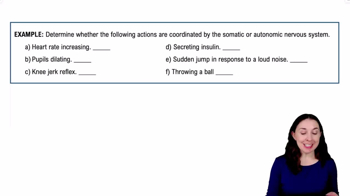
Introduction to the Autonomic Nervous System Example 1

Emotional-Visceral System

This term emphasizes the ANS's involvement in emotional responses by regulating visceral organs. Emotional states like stress or fear trigger autonomic changes, linking emotions to physiological reactions such as increased heart rate or sweating.
Recommended video:
2:12
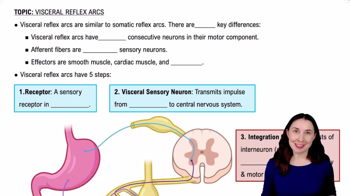
Visceral Reflex Arcs