Ch. 14 The Autonomic Nervous System
Hoehn - Marieb Human Anatomy & Physiology, 12th edition
Hoehn, Haynes, Abbott12th EditionMarieb Human Anatomy & PhysiologyISBN: 9780138242732Not the one you use?Change textbook
Chapter 14, Problem 1

All of the following characterize the ANS except
a. A two-neuron efferent chain
b. Presence of neuron cell bodies in the CNS
c. Presence of neuron cell bodies in the ganglia
d. Innervation of skeletal muscles

Verified step by step guidance
1
Step 1: Understand the Autonomic Nervous System (ANS) characteristics. The ANS controls involuntary functions and typically involves a two-neuron efferent pathway: a preganglionic neuron with its cell body in the CNS and a postganglionic neuron with its cell body in a peripheral ganglion.
Step 2: Analyze option (a): 'A two-neuron efferent chain.' This is a defining feature of the ANS, where signals travel from the CNS to a ganglion and then to the target organ.
Step 3: Analyze option (b): 'Presence of neuron cell bodies in the CNS.' The preganglionic neurons of the ANS have their cell bodies in the CNS, so this is true for the ANS.
Step 4: Analyze option (c): 'Presence of neuron cell bodies in the ganglia.' The postganglionic neurons of the ANS have their cell bodies in autonomic ganglia, so this is also true.
Step 5: Analyze option (d): 'Innervation of skeletal muscles.' The ANS does not innervate skeletal muscles; instead, the somatic nervous system controls skeletal muscle. Therefore, this option does not characterize the ANS.

Verified video answer for a similar problem:

This video solution was recommended by our tutors as helpful for the problem above.
Video duration:
1m
Was this helpful?

Key Concepts

Here are the essential concepts you must grasp in order to answer the question correctly.

Autonomic Nervous System (ANS) Structure

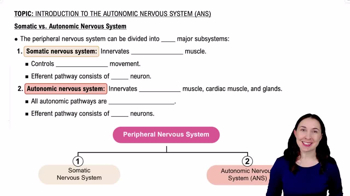
The ANS typically consists of a two-neuron efferent pathway: a preganglionic neuron with its cell body in the CNS and a postganglionic neuron located in peripheral ganglia. This structure allows for modulation of involuntary functions.
Recommended video:
1:50
Somatic vs. Autonomic Nervous System

Location of Neuron Cell Bodies in the ANS

In the ANS, preganglionic neuron cell bodies reside in the central nervous system (brain or spinal cord), while postganglionic neuron cell bodies are found in autonomic ganglia outside the CNS. This arrangement is key to autonomic signal transmission.
Recommended video:
Guided course
2:45
Organization of the Body: Serous Membrane Locations Example 1

Target Innervation of the ANS

The ANS innervates involuntary effectors such as smooth muscle, cardiac muscle, and glands. It does not innervate skeletal muscles, which are controlled by the somatic nervous system, making this a distinguishing feature.
Recommended video:
2:50
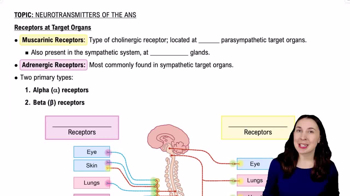
Receptors at Target Organs