Ch. 13 The Peripheral Nervous System and Reflex Activity
Hoehn - Marieb Human Anatomy & Physiology, 12th edition
Hoehn, Haynes, Abbott12th EditionMarieb Human Anatomy & PhysiologyISBN: 9780138242732Not the one you use?Change textbook
Chapter 13, Problem 15

What is the functional relationship of the peripheral nervous system to the central nervous system?

Verified step by step guidance
1
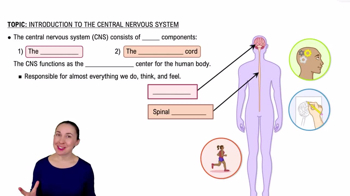
Step 1: Understand the definitions of the two systems. The Central Nervous System (CNS) consists of the brain and spinal cord, which process and integrate information.
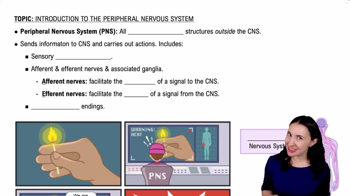
Step 2: Recognize that the Peripheral Nervous System (PNS) includes all the nerves outside the CNS, such as cranial and spinal nerves, which connect the CNS to limbs and organs.
Step 3: Identify the functional relationship: the PNS acts as a communication network that transmits sensory information from the body to the CNS and carries motor commands from the CNS to muscles and glands.
Step 4: Note that the PNS is divided into the sensory (afferent) division, which sends signals to the CNS, and the motor (efferent) division, which sends signals from the CNS to effectors.
Step 5: Summarize that the PNS serves as the link that allows the CNS to receive input from the external and internal environment and to respond appropriately by controlling bodily functions.

Key Concepts

Here are the essential concepts you must grasp in order to answer the question correctly.

Central Nervous System (CNS)

The CNS consists of the brain and spinal cord, serving as the main control center for processing information and coordinating bodily functions. It interprets sensory data and sends out instructions to the body.
Recommended video:
1:32
The Central Nervous System

Peripheral Nervous System (PNS)

The PNS includes all nerves outside the CNS, connecting the brain and spinal cord to limbs and organs. It transmits sensory information to the CNS and carries motor commands from the CNS to muscles and glands.
Recommended video:
3:33
Peripheral Nervous System

Functional Relationship between PNS and CNS

The PNS acts as a communication network linking the body to the CNS, enabling sensory input to reach the CNS and motor output to be delivered to effectors. This bidirectional flow allows the CNS to regulate and respond to internal and external stimuli.
Recommended video:
6:40
Relationship Between Blood Flow, Pressure, & Resistance