Ch. 13 The Peripheral Nervous System and Reflex Activity
Hoehn - Marieb Human Anatomy & Physiology, 12th edition
Hoehn, Haynes, Abbott12th EditionMarieb Human Anatomy & PhysiologyISBN: 9780138242732Not the one you use?Change textbook
Chapter 13, Problem 4

The neural machinery of the spinal cord is at the
(a) precommand level
(b) projection level
(c) segmental level

Verified step by step guidance
1
Understand the hierarchical organization of motor control in the nervous system, which includes the precommand level, projection level, and segmental level.
Recognize that the precommand level involves higher brain areas like the cerebellum and basal nuclei that plan and coordinate complex movements.
Know that the projection level consists of motor cortex and brainstem nuclei that send commands to the spinal cord.
Identify that the segmental level refers to the neural circuits within the spinal cord itself, which directly control reflexes and simple motor patterns.
Conclude that since the question asks about the neural machinery of the spinal cord, it corresponds to the segmental level, where local circuits generate reflexes and basic motor outputs.

Key Concepts

Here are the essential concepts you must grasp in order to answer the question correctly.

Precommand Level

The precommand level involves higher brain centers such as the cerebellum and basal ganglia that plan and coordinate complex motor activities before sending instructions to lower levels. It is responsible for initiating voluntary movements and ensuring smooth execution.
Recommended video:
Guided course
05:04
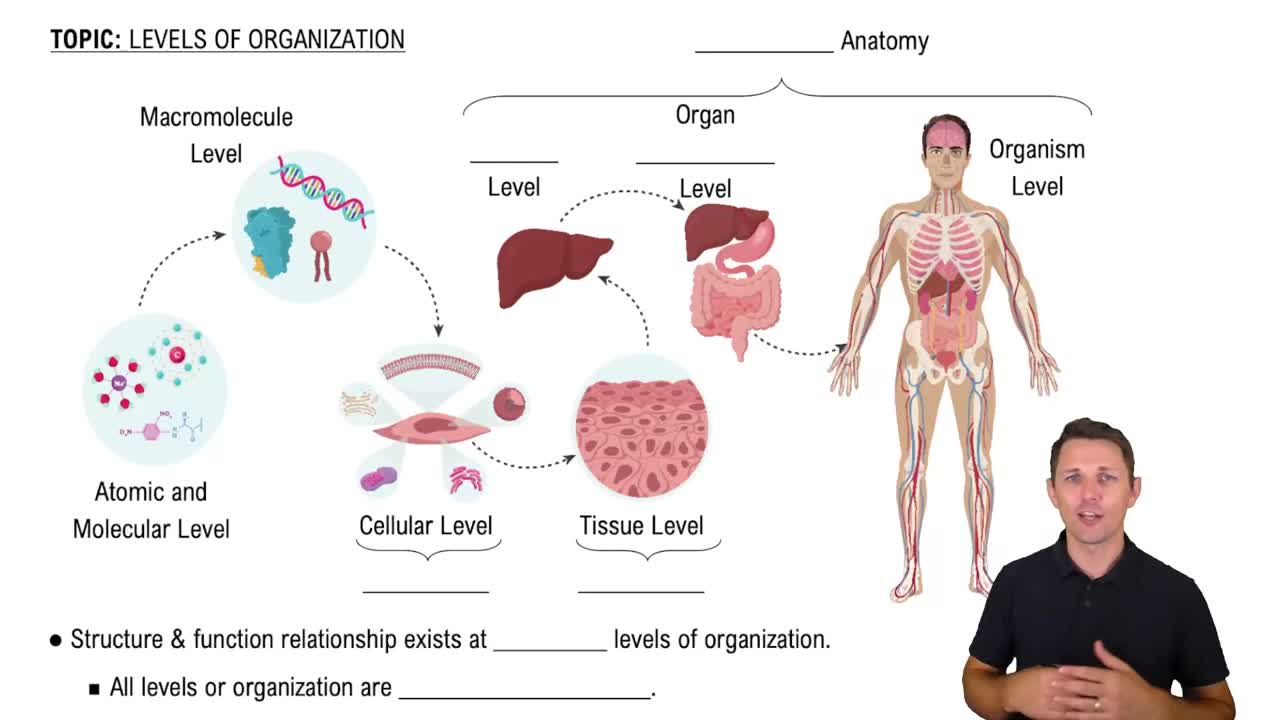
The Levels of Organization

Projection Level

The projection level consists of motor cortex and brainstem neurons that send commands to the spinal cord. This level translates motor plans into specific instructions for muscle activation, acting as a relay between higher brain centers and the spinal cord.
Recommended video:
Guided course
05:04
The Levels of Organization

Segmental Level

The segmental level refers to the neural circuits within the spinal cord that directly control reflexes and simple motor patterns. It processes sensory input and generates motor output at the level of individual spinal segments, enabling basic movements and reflex actions.
Recommended video:
Guided course
05:04
The Levels of Organization
Related Practice
Textbook Question

The large onion-shaped receptors that are found deep in the dermis and in subcutaneous tissue and that respond to deep pressure are

a. Epithelial tactile complexes

b. Lamellar corpuscles

c. Free nerve endings

d. Muscle spindles

3
views
1
rank
Textbook Question

Proprioceptors include all of the following except

a. Muscle spindles

b. Tendon organs

c. Epithelial tactile complexes

d. Joint kinesthetic receptors

1
views
Textbook Question

Match the names of the cranial nerves in column B to the appropriate description in column A.

Column A 

_______    (1) Causes pupillary constriction 

_______    (2) The major sensory nerve of the face

_______    (3) Serves the sternocleido-mastoid and trapezius muscles 

_______    (4) Purely sensory (two nerves) 

_______    (5) Serves the tongue muscles 

_______    (6) Allows you to chew your food 

_______    (7) Impaired in Bell's palsy

_______    (8) Helps regulate heart activity

_______    (9) Helps you hear and maintain your balance 

_______   (10) Contain parasympathetic motor fibers (four nerves)

Column B

a. Abducens

b. Accessory

c. Facial

d. Glossopharyngeal

e. Hypoglossal

f. Oculomotor

g. Olfactory

h. Optic

i. Trigeminal

j. Trochlear

k. Vagus

l. Vestibulocochlear

1
views
Textbook Question

Match the receptor type in column B to the correct description in column A.

Column A

______    (1) Pain, itch, and temperature receptors

______    (2) Contains intrafusal fibers and anulospiral and flower spray endings

______    (3) Discriminative touch receptor in hairless skin (fingertips)

______    (4) Contains receptor endings wrapped around thick collagen bundles

______    (5) Rapidly adapting deep-pressure receptor

______    (6) Slowly adapting deep-pressure receptor

Column B

a. Bulbous corpuscles

b. Tendon organ

c. Muscle spindle

d. Free nerve endings

e. Lamellar corpuscle

f. Tactile corpuscle

2
views