Ch. 13 The Peripheral Nervous System and Reflex Activity
Hoehn - Marieb Human Anatomy & Physiology, 12th edition
Hoehn, Haynes, Abbott12th EditionMarieb Human Anatomy & PhysiologyISBN: 9780138242732Not the one you use?Change textbook
Chapter 13, Problem 18

Make a diagram of the hierarchy of motor control. Position the CPGs, motor cortex, brain stem nuclei, cerebellum, and basal nuclei in this scheme.

Verified step by step guidance
1
Start by understanding the overall hierarchy of motor control, which involves multiple brain regions working together to plan, initiate, and execute movement.
At the top of the hierarchy, place the motor cortex, as it is responsible for voluntary movement planning and initiation.
Next, position the basal nuclei (also called basal ganglia) and cerebellum as modulatory centers that influence motor commands. The basal nuclei help regulate movement initiation and inhibit unwanted movements, while the cerebellum coordinates timing and precision.
Below these, place the brain stem nuclei, which act as relay centers and integrate motor commands from higher centers to the spinal cord, also controlling posture and basic motor patterns.
Finally, position the Central Pattern Generators (CPGs) at the spinal cord level, as they generate rhythmic motor patterns such as walking without requiring direct input from higher brain centers.

Key Concepts

Here are the essential concepts you must grasp in order to answer the question correctly.

Hierarchy of Motor Control

The hierarchy of motor control refers to the organized levels at which the nervous system plans, initiates, and regulates movement. It ranges from higher brain centers like the motor cortex to lower centers such as spinal circuits, ensuring smooth and coordinated motor output.
Recommended video:
2:05
Control of the ANS Example 2

Central Pattern Generators (CPGs)

CPGs are neural networks located in the spinal cord and brainstem that produce rhythmic, patterned motor outputs like walking or breathing without sensory feedback. They function as fundamental units for generating repetitive movements autonomously.
Recommended video:
4:24
Pattern Recognition Receptors

Role of Motor Cortex, Brain Stem Nuclei, Cerebellum, and Basal Nuclei

The motor cortex initiates voluntary movement and sends commands to lower centers; brain stem nuclei mediate posture and reflexes; the cerebellum coordinates timing and precision of movements; basal nuclei regulate movement initiation and inhibit unwanted motions, all integrating to control motor behavior.
Recommended video:
3:26
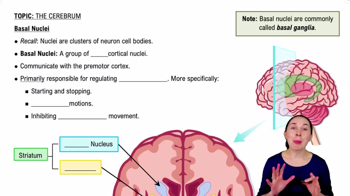
Basal Nuclei