Ch. 12 The Central Nervous System
Hoehn - Marieb Human Anatomy & Physiology, 12th edition
Hoehn, Haynes, Abbott12th EditionMarieb Human Anatomy & PhysiologyISBN: 9780138242732Not the one you use?Change textbook
Chapter 12, Problem 23

Robert, a brilliant computer analyst, suffered a blow to his anterior skull from a falling rock while mountain climbing. Shortly thereafter, it was obvious to his coworkers that his behavior had undergone a dramatic change. Although previously a smart dresser, he was now unkempt. One morning, he was observed defecating into the wastebasket. Which region of Robert's brain was affected by the cranial blow?

Verified step by step guidance
1
Step 1: Identify the key symptoms described in the problem: a dramatic change in behavior, loss of social norms (e.g., unkempt appearance), and inappropriate actions (e.g., defecating into a wastebasket). These symptoms suggest impairment in personality, decision-making, and social behavior.
Step 2: Recall the brain regions responsible for personality, social behavior, and executive functions. The prefrontal cortex, especially the frontal lobe, is known to regulate these higher cognitive functions and social conduct.
Step 3: Understand that the anterior skull blow likely affected the frontal lobe, as it is located at the front of the brain beneath the forehead and anterior skull.
Step 4: Connect the behavioral changes to damage in the prefrontal cortex, which is part of the frontal lobe. Damage here can lead to disinhibition, poor judgment, and changes in personality, consistent with Robert's symptoms.
Step 5: Conclude that the region of Robert's brain affected by the cranial blow is the frontal lobe, specifically the prefrontal cortex, which explains the observed behavioral changes.

Verified video answer for a similar problem:

This video solution was recommended by our tutors as helpful for the problem above.
Video duration:
3m
Was this helpful?

Key Concepts

Here are the essential concepts you must grasp in order to answer the question correctly.

Frontal Lobe Function

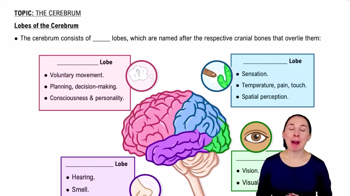
The frontal lobe is responsible for executive functions such as decision-making, social behavior, and personality. Damage to this area can result in changes in behavior, poor judgment, and loss of social inhibitions, which explains Robert's altered conduct after the injury.
Recommended video:
2:50
Lobes of the Cerebrum

Prefrontal Cortex Role

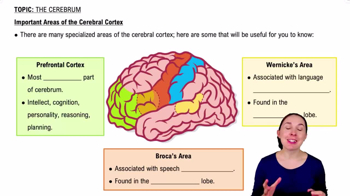
The prefrontal cortex, part of the frontal lobe, regulates complex cognitive behavior and moderates social behavior. Injury here often leads to disinhibition, impulsivity, and inappropriate actions, such as Robert's unkempt appearance and socially unacceptable behavior.
Recommended video:
3:15
Important Areas of the Cerebral Cortex

Localization of Brain Injury Symptoms

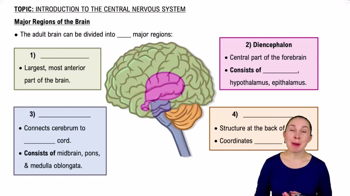
Identifying brain injury symptoms helps localize the affected region. Behavioral changes, loss of social norms, and poor self-care typically indicate damage to the anterior frontal regions, especially the prefrontal cortex, rather than other brain areas like the occipital or temporal lobes.
Recommended video:
3:10
Major Regions of the Brain
Related Practice
Textbook Question

a. Define cerebrovascular accident or CVA.

b. Describe its possible causes and consequences.

1
views

Textbook Question

Describe the functional problems that would be experienced by a person in which these fiber tracts have been cut:

a. Lateral spinothalamic

b. Ventral and dorsal spinocerebellar

c. Tectospinal

Textbook Question

a. How is cerebrospinal fluid formed and drained? Describe its pathway within and around the brain.

b What happens if CSF does not drain properly? Why is this consequence more harmful in adults?

Textbook Question

Mrs. Jones has had a progressive decline in her mental capabilities in the last five or six years. At first her family attributed her occasional memory lapses, confusion, and agitation to grief over her husband's death six years earlier. When examined, Mrs. Jones was aware of her cognitive problems and was shown to have an IQ score approximately 30 points less than would be predicted by her work history. A CT scan showed diffuse cerebral atrophy. The physician prescribed an acetylcholinesterase inhibitor and Mrs. Jones showed slight improvement. What is Mrs. Jones's problem? Why did the acetylcholinesterase inhibitor help?

3
views
Textbook Question

Describe the spinal cord, depicting its extent, its composition of gray and white matter, and its spinal roots.

1
views
Textbook Question

A 10-month-old infant has an enlarging head circumference and delayed overall development. Her CSF pressure is elevated, and she has a bulging anterior fontanelle (fontanelles are the as yet unossified fibrous membranes connecting skull bones in infants). Based on these findings, answer the following questions:

a. What are the possible cause(s) of an enlarged head?

b. Which tests might be helpful in obtaining information about this infant's problem?

c. Assuming the tests conducted showed the cerebral aqueduct to be constricted, which ventricles or CSF-containing areas would you expect to be enlarged? Which would likely not be visible? Respond to the same questions based on a finding of obstructed arachnoid granulations.