During a neurobiology lecture, a professor repeatedly refers to group A and group B fibers, absolute refractory period, and myelin sheath gaps. Define these terms.
Ch. 11 Fundamentals of the Nervous System and Nervous Tissue
Hoehn, Haynes, Abbott12th EditionMarieb Human Anatomy & PhysiologyISBN: 9780138242732Not the one you use?Change textbook
All textbooks
Hoehn, Haynes, Abbott 12th Edition
Ch. 11 Fundamentals of the Nervous System and Nervous Tissue
Problem 12
Hoehn, Haynes, Abbott 12th Edition
Ch. 11 Fundamentals of the Nervous System and Nervous Tissue
Problem 12Chapter 11, Problem 12
Since all APs generated by a given nerve fiber have the same magnitude, how does the CNS 'know' whether a stimulus is strong or weak?
Verified step by step guidance1
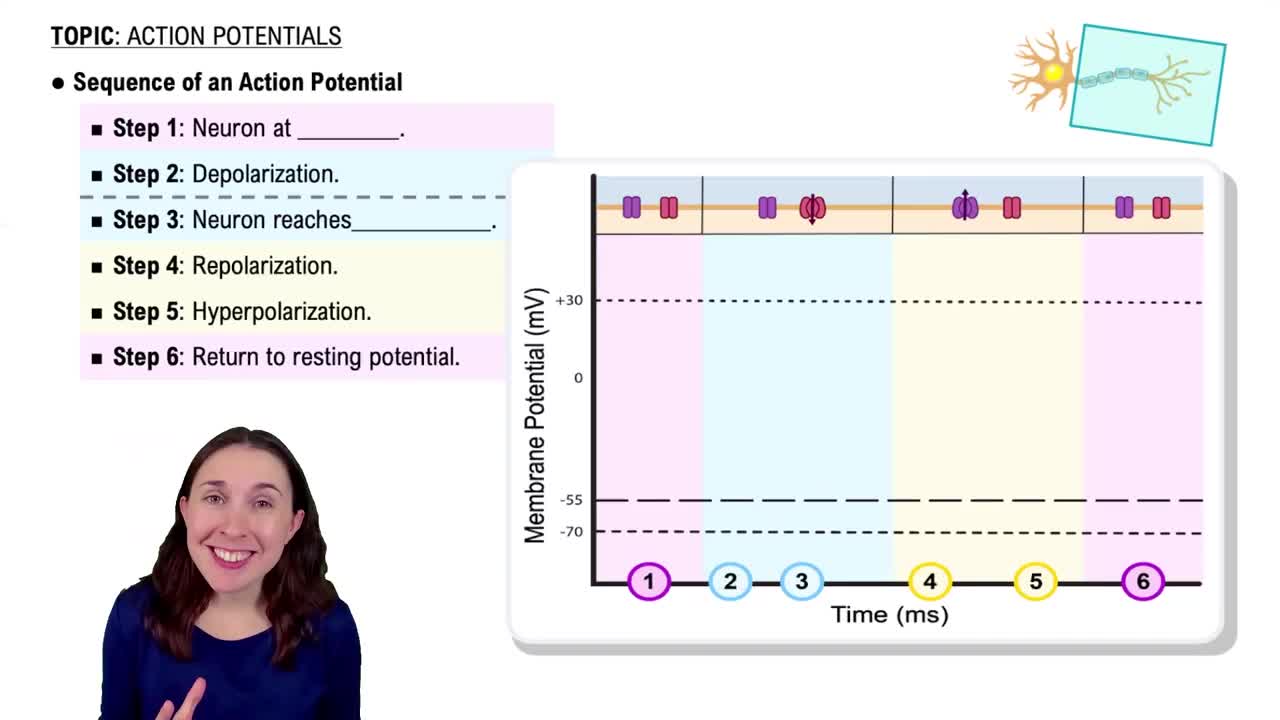
Understand that an action potential (AP) in a nerve fiber is an all-or-none event, meaning each AP has the same magnitude regardless of stimulus strength.
Recognize that the central nervous system (CNS) differentiates stimulus intensity not by the size of individual APs but by the frequency of APs generated in the nerve fiber; this is called frequency coding.
Consider that a stronger stimulus causes the nerve fiber to fire APs at a higher frequency, increasing the number of APs per unit time.
Also note that the CNS can interpret stimulus strength by the number of nerve fibers activated simultaneously, known as population coding or recruitment.
Summarize that the CNS 'knows' stimulus strength through the rate of AP firing (frequency) and the number of fibers activated, rather than the magnitude of individual APs.

Verified video answer for a similar problem:
This video solution was recommended by our tutors as helpful for the problem above.
Video duration:
4mWas this helpful?
Key Concepts
Here are the essential concepts you must grasp in order to answer the question correctly.
All-or-None Principle of Action Potentials
Action potentials (APs) generated by a nerve fiber follow the all-or-none principle, meaning each AP has a uniform magnitude and duration regardless of stimulus strength. This ensures that the signal transmitted along the neuron is consistent, preventing variations in AP size from encoding stimulus intensity.
Recommended video:
Action Potential
Frequency Coding of Stimulus Intensity
The central nervous system interprets stimulus strength by the frequency of action potentials rather than their size. Stronger stimuli cause nerve fibers to fire APs at higher rates, increasing the number of signals sent per unit time, which the CNS decodes as increased intensity.
Recommended video:
Genetic Code
Population Coding and Recruitment of Nerve Fibers
In addition to frequency coding, stronger stimuli recruit more nerve fibers to fire action potentials simultaneously. This population coding allows the CNS to assess stimulus intensity based on how many neurons are active, providing a broader representation of stimulus strength.
Recommended video:
Genetic Code
Related Practice
Textbook Question
1
views
Textbook Question
The velocity of nerve impulse conduction is greatest in
a. Heavily myelinated, large-diameter fibers
b. Myelinated, small-diameter fibers
c. Nonmyelinated, small-diameter fibers
d. Nonmyelinated, large-diameter fibers
1
views
Textbook Question
An IPSP is inhibitory because
a. It hyperpolarizes the postsynaptic membrane.
b. It reduces the amount of neurotransmitter released by the presynaptic terminal.
c. It prevents calcium ion entry into the presynaptic terminal.
d. It changes the threshold of the neuron.
1
views
Textbook Question
a. What is myelin?
b. How does the myelination process differ in the CNS and PNS?
1
views
Textbook Question
The anatomical region of a multipolar neuron where the AP is initiated is the
a. Soma
b. Dendrites
c. Axon's initial segment
d. Axon terminals
1
views