Ch. 10 The Muscular System
Hoehn - Marieb Human Anatomy & Physiology, 12th edition
Hoehn, Haynes, Abbott12th EditionMarieb Human Anatomy & PhysiologyISBN: 9780138242732Not the one you use?Change textbook
Chapter 10, Problem 23

As Kendra's coach watched her sail over the high jump bar, he contracted his right orbicularis oculi muscle, raised his arm, and contracted his opponens pollicis. Was he pleased or displeased with her performance? How do you know?

Verified step by step guidance
1
Identify the muscles mentioned and their typical functions: the orbicularis oculi muscle is responsible for closing the eyelids, often involved in blinking or winking; the opponens pollicis muscle allows the thumb to oppose or touch the other fingers, enabling a 'thumbs up' gesture.
Consider the context of the coach's actions: contracting the orbicularis oculi muscle to close or wink the eye, raising the arm, and contracting the opponens pollicis to oppose the thumb suggests a deliberate gesture.
Recall common nonverbal gestures associated with approval or disapproval: a 'thumbs up' is widely recognized as a sign of approval or being pleased, often accompanied by a wink or eye closure to emphasize the positive message.
Analyze the combination of muscle contractions and arm movement as a coordinated gesture indicating the coach's emotional response to Kendra's performance.
Conclude that the coach was pleased with Kendra's jump because the muscle actions correspond to a 'thumbs up' and wink, both positive signals.

Verified video answer for a similar problem:

This video solution was recommended by our tutors as helpful for the problem above.
Video duration:
1m
Was this helpful?

Key Concepts

Here are the essential concepts you must grasp in order to answer the question correctly.

Orbicularis Oculi Muscle Function

The orbicularis oculi is a facial muscle responsible for closing the eyelids. Its contraction is commonly associated with blinking, winking, or expressing emotions such as genuine happiness, often seen in a Duchenne smile where the eyes crinkle.
Recommended video:
06:04
Functional Groups

Opponens Pollicis Muscle Action

The opponens pollicis is a muscle in the hand that enables the thumb to oppose or touch the other fingers. Contracting this muscle typically allows for gestures like a thumbs-up, which is widely recognized as a sign of approval or positive feedback.
Recommended video:
Guided course
5:41
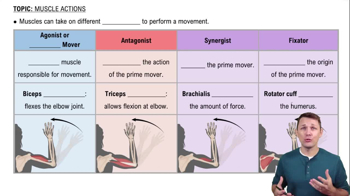
Muscle Actions

Nonverbal Communication and Emotional Expression

Nonverbal cues, including facial expressions and hand gestures, convey emotions and reactions without words. A combination of orbicularis oculi contraction (smiling eyes) and a thumbs-up gesture usually indicates pleasure or approval, helping interpret the coach's feelings about Kendra's performance.
Recommended video:
2:59
Map of the Lesson on Cell Communication
Related Practice
Textbook Question

Assume you have a 10-lb weight in your right hand. Explain why it is easier to flex the right elbow when your forearm is supinated than when it is pronated.

1
views

Textbook Question

Mr. Ahmadi, an out-of-shape 45-year-old man, was advised by his physician to lose weight and to exercise on a regular basis. He followed his diet faithfully and began to jog daily. One day, while on his morning jog, he heard a snapping sound that was immediately followed by a severe pain in his right lower calf. When his leg was examined, a gap was seen between his swollen upper calf region and his heel, and he was unable to plantar flex that ankle. What do you think happened? Why was the upper part of his calf swollen?

1
views
Textbook Question

Name two muscles in each of the following compartments or regions:

a. thenar eminence (ball of thumb)

b. posterior compartment of forearm

c. anterior compartment of forearm—deep muscle group

d. anterior muscle group in the arm

e. muscles of mastication

1
views
Textbook Question

a. Name the four muscle pairs that act in unison to compress the abdominal contents.

b. How does their arrangement (fiber direction) contribute to the strength of the abdominal wall?

c. Which of these muscles can effect lateral rotation of the spine?

d. Which can act alone to flex the spine?

1
views
Textbook Question

When Mrs. O'Brien returned to her doctor for a follow-up visit after childbirth, she complained that she was incontinent (having problems controlling her urine flow) when she sneezed. The physician asked his nurse to give Mrs. O'Brien instructions on how to perform exercises to strengthen the muscles of the pelvic floor. To which muscles was he referring?

1
views
Textbook Question

What class of lever system do the following activities describe?

a. The soleus muscle plantar flexes the foot.

b. The triceps brachii is strained while doing pushups.

1
views