Ch. 8 Articulations
Amerman- Human Anatomy & Physiology 3e
Amerman3rd EditionHuman Anatomy & PhysiologyISBN: 9780138247201, 9780138247928, 9780138201814Not the one you use?Change textbook
Chapter 8, Problem L3.3

When articular cartilage is damaged, often fibrocartilage forms instead of new hyaline cartilage. Does fibrocartilage have the same properties as hyaline cartilage? Is it likely to provide the same type of surface as hyaline cartilage? Explain. (Connects to Chapter 4)

Verified step by step guidance
1
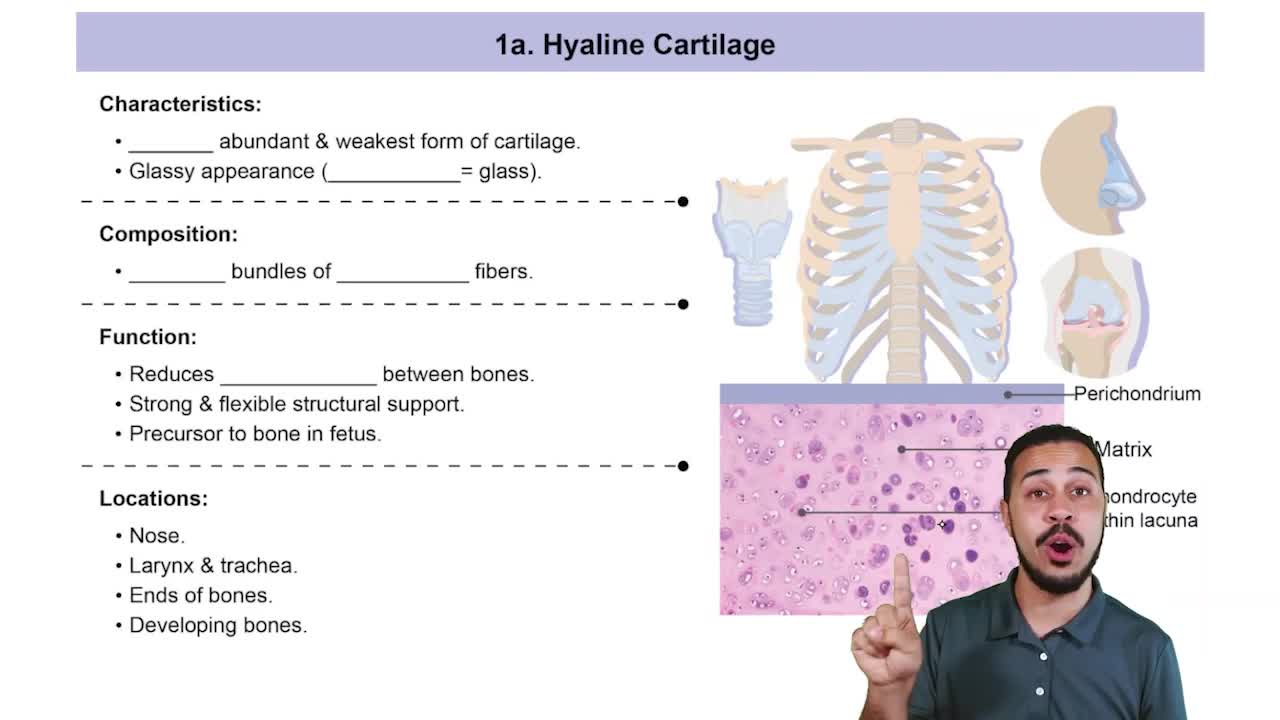
Understand the properties of hyaline cartilage: Hyaline cartilage is a smooth, glass-like tissue that covers the ends of bones in synovial joints. It provides a low-friction surface for joint movement and absorbs shock due to its resilience and elasticity.
Learn the properties of fibrocartilage: Fibrocartilage is tougher and more fibrous than hyaline cartilage. It contains dense bundles of collagen fibers, making it better suited for resisting compressive and tensile forces but less smooth and elastic compared to hyaline cartilage.
Compare the structural differences: Hyaline cartilage has a high concentration of proteoglycans and a smooth matrix, while fibrocartilage has a rougher texture due to its dense collagen fibers. This structural difference impacts their functional properties.
Evaluate the functional implications: Fibrocartilage is not as smooth or elastic as hyaline cartilage, meaning it cannot provide the same low-friction surface for joint movement. It is more suited for areas requiring durability, such as intervertebral discs or menisci, rather than articular surfaces.
Conclude the likelihood of replacement: When fibrocartilage forms instead of hyaline cartilage, it is unlikely to provide the same type of surface or functionality. This can lead to reduced joint efficiency and increased wear and tear over time.

Verified video answer for a similar problem:

This video solution was recommended by our tutors as helpful for the problem above.
Was this helpful?

Key Concepts

Here are the essential concepts you must grasp in order to answer the question correctly.

Articular Cartilage

Articular cartilage is a smooth, white tissue that covers the ends of bones where they come together to form joints. It provides a low-friction surface for joint movement and absorbs shock, playing a crucial role in joint health. Damage to this cartilage can lead to pain and reduced mobility, making its properties essential for understanding joint function.
Recommended video:
Guided course
05:36
Hyaline Cartilage

Fibrocartilage vs. Hyaline Cartilage

Fibrocartilage and hyaline cartilage are two types of cartilage with distinct properties. Hyaline cartilage is smooth and resilient, providing a gliding surface for joints, while fibrocartilage is tougher and more fibrous, designed to withstand tension and pressure. This difference in composition affects their functionality and the type of surface they provide in joints.
Recommended video:
Guided course
05:36
Hyaline Cartilage

Cartilage Repair and Regeneration

Cartilage repair and regeneration refer to the body's ability to heal damaged cartilage. However, the repair process often results in the formation of fibrocartilage instead of hyaline cartilage, which can lead to inferior mechanical properties and surface characteristics. Understanding this process is vital for evaluating joint health and the effectiveness of treatments for cartilage injuries.
Recommended video:
03:20
DNA Repair