
Ch. 7 The Skeletal System
Amerman- Human Anatomy & Physiology 3e
Amerman3rd EditionHuman Anatomy & PhysiologyISBN: 9780138247201, 9780138247928, 9780138201814Not the one you use?Change textbook
Chapter 7, Problem L3.1

Some health practitioners claim that the cranial bones are moveable and that they are able to move these bones to treat a variety of conditions. Is this likely to be true in an adult? Why or why not?

Verified step by step guidance
1
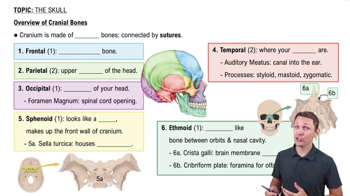
Understand the anatomy of cranial bones: The cranial bones in adults are part of the skull, which protects the brain and provides structure to the head. These bones include the frontal, parietal, occipital, temporal, sphenoid, and ethmoid bones.
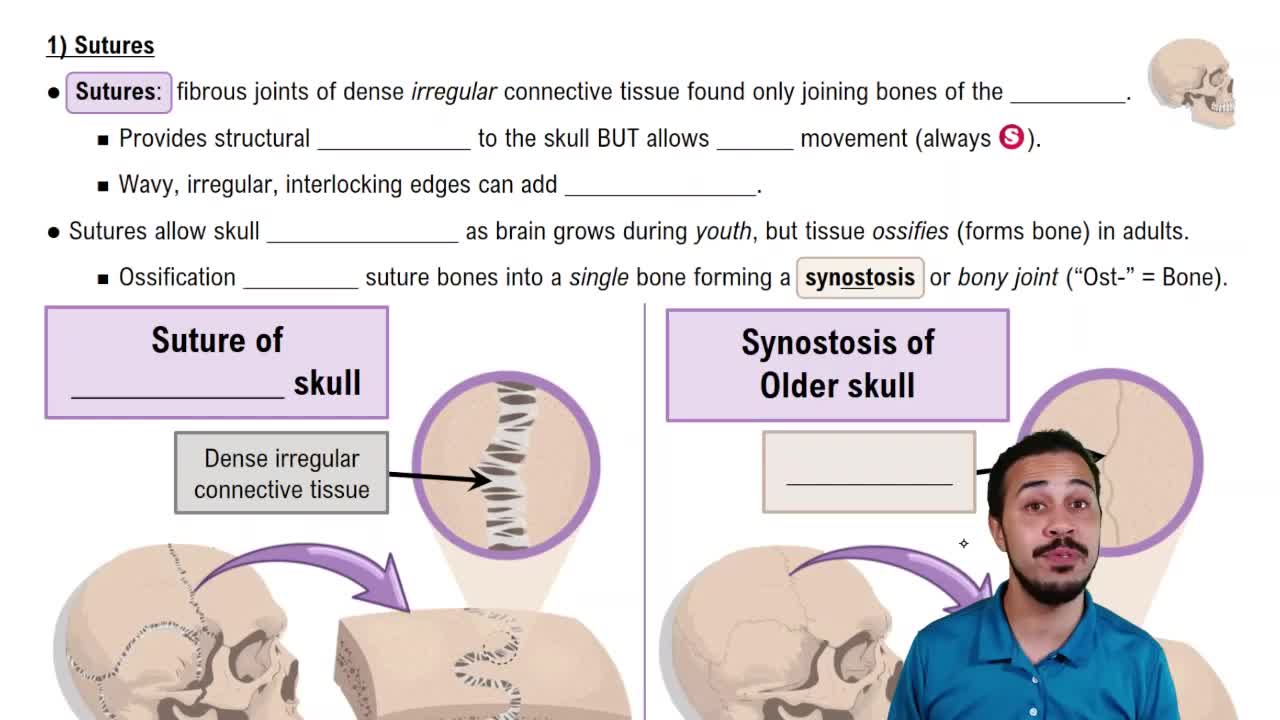
Learn about cranial sutures: In adults, the cranial bones are connected by immovable joints called sutures. These sutures are fibrous connections that fuse the bones together, providing stability and protection for the brain.
Consider the developmental process: During infancy and childhood, cranial bones are not fully fused, allowing for flexibility during birth and brain growth. However, as a person matures, these sutures ossify (harden) and become immovable in adulthood.
Evaluate the claim: Since the cranial sutures are immovable in adults, it is unlikely that health practitioners can move cranial bones to treat conditions. The claim may stem from practices like craniosacral therapy, which focuses on subtle manipulations, but these movements are not supported by anatomical evidence of bone mobility.
Conclude based on evidence: The cranial bones in adults are fused and immovable, making it anatomically improbable for them to be moved. Treatments claiming to move cranial bones should be critically evaluated for scientific validity.

Verified video answer for a similar problem:

This video solution was recommended by our tutors as helpful for the problem above.
Was this helpful?

Key Concepts

Here are the essential concepts you must grasp in order to answer the question correctly.

Cranial Bone Structure

The human skull is composed of 22 bones, which are primarily fused together by sutures in adults. These sutures are immovable joints that provide stability and protection for the brain. While cranial bones can exhibit slight movement during infancy and childhood, they become rigid in adulthood, making significant movement unlikely.
Recommended video:
Guided course
8:20
Overview of Cranial Bones

Craniosacral Therapy

Craniosacral therapy is a form of alternative medicine that claims to manipulate the cranial bones to improve health. Practitioners believe that subtle movements of the skull can influence the central nervous system and overall well-being. However, scientific evidence supporting the efficacy of this practice is limited, and it remains controversial within the medical community.
Recommended video:
07:43
CRISPR CAS

Sutural Mobility

Sutural mobility refers to the potential for movement at the sutures between cranial bones. In adults, these sutures are typically fused and do not allow for significant movement. While some minor flexibility may exist, it is insufficient to support claims of therapeutic manipulation for treating conditions, as the primary function of these sutures is to protect the brain.
Recommended video:
07:31
Sutures
Related Practice
Textbook Question

Predict where each of the following structures is located, based on your knowledge of skeletal anatomy and anatomical terms (your answers should be along the lines of 'lateral crural region' or 'posterior cervical region').


a. Frontal lobe of brain

b. Suprahyoid muscle

c. Ulnar artery

d. Tibial nerve

e. Intercostal muscle

f. External iliac artery

1
views
Textbook Question

Ms. Hendrix suffered a severe hip fracture that required hip replacement surgery. After an extended recovery period, she is undergoing physical therapy to regain strength and mobility.

Which bone is involved in a hip fracture, and what part of the bone is likely to be fractured?

2
views
Textbook Question

The two parietal bones are united at the_______suture; they meet the frontal bone at the_____ suture, the temporal bones at the______ sutures, and the occipital bone at the_____suture.

3
views
Textbook Question

How do the atlas (C1) and the axis (C2) differ from other cervical vertebrae? How does this difference enable them to perform their functions?

2
views
Textbook Question

A deviated septum results when the nasal septum is shifted to one side or the other. What bones might be involved in this condition? Why might this make breathing difficult?

2
views
Textbook Question

You arrive on the scene where a person without a pulse was found. Someone on the scene performed CPR, but the individual unfortunately could not be revived. On postmortem examination, it is discovered that several ribs and the xiphoid process were fractured. What likely caused these fractures?

4
views