Ch. 27 Development and Heredity
Amerman- Human Anatomy & Physiology 3e
Amerman3rd EditionHuman Anatomy & PhysiologyISBN: 9780138247201, 9780138247928, 9780138201814Not the one you use?Change textbook
Chapter 27, Problem L3.3

Determine the probability of a couple having a child with a widow's peak if the conditions are as follows: The gene for widow's peak follows strict autosomal dominant-recessive inheritance. Widow's peak (W) is dominant, and no widow's peak (w) is recessive. The genotype of the mother is Ww, and the genotype of the father is ww.

Verified step by step guidance
1
Step 1: Understand the inheritance pattern. Widow's peak is an autosomal dominant trait, meaning only one dominant allele (W) is needed for the trait to be expressed. The recessive allele (w) will only result in no widow's peak if both alleles are recessive (ww).
Step 2: Write down the genotypes of the parents. The mother has the genotype Ww (heterozygous), meaning she carries one dominant allele (W) and one recessive allele (w). The father has the genotype ww (homozygous recessive), meaning he carries two recessive alleles (w).
Step 3: Set up a Punnett square to determine the possible genotypes of the offspring. Place the mother's alleles (W and w) on one side of the square and the father's alleles (w and w) on the other side.
Step 4: Fill in the Punnett square by combining the alleles from the mother and father. This will give you the possible genotypes of the offspring: Ww (widow's peak) and ww (no widow's peak).
Step 5: Calculate the probability of each genotype. Count the number of squares with Ww (dominant phenotype) and ww (recessive phenotype) and divide by the total number of squares (4). This will give you the probability of the child having a widow's peak.

Verified video answer for a similar problem:

This video solution was recommended by our tutors as helpful for the problem above.
Was this helpful?

Key Concepts

Here are the essential concepts you must grasp in order to answer the question correctly.

Autosomal Dominant and Recessive Inheritance

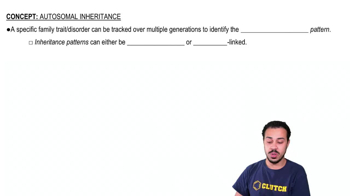
Autosomal inheritance refers to the transmission of genes located on the autosomes, which are the non-sex chromosomes. In this context, a dominant allele (W) will express its trait even if only one copy is present, while a recessive allele (w) requires two copies to express the trait. Understanding this distinction is crucial for predicting the inheritance patterns of traits like widow's peak.
Recommended video:
01:02
Autosomal Inheritance

Genotype and Phenotype

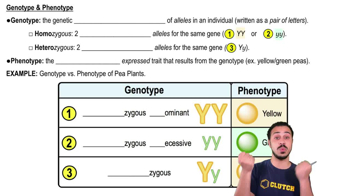
The genotype is the genetic makeup of an individual, represented by the alleles they possess (e.g., Ww or ww). The phenotype is the observable expression of the genotype, such as having a widow's peak or not. In this scenario, knowing the genotypes of the parents allows us to predict the potential phenotypes of their offspring.
Recommended video:
06:36
Genotype & Phenotype

Punnett Square

A Punnett square is a diagram used to predict the genetic outcomes of a cross between two individuals. It helps visualize the possible combinations of alleles from each parent, allowing for the calculation of probabilities for different genotypes and phenotypes in the offspring. This tool is essential for determining the likelihood of the couple having a child with a widow's peak.
Recommended video:
07:23
X-Linked Inheritance