
Textbook Question
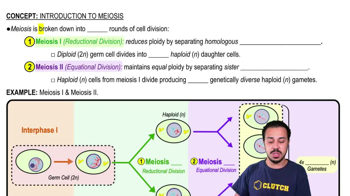
At the end of meiosis, each cell has ________ chromosomes and they are genetically ________ from the original cell.
1
views

 Verified step by step guidance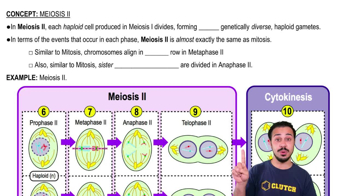
 6:17
6:17
 4:49
4:49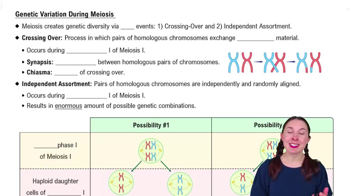 5:19
5:19At the end of meiosis, each cell has ________ chromosomes and they are genetically ________ from the original cell.
Match the specific phase of meiosis with the correct description.
________Prophase I
________Metaphase I
________Anaphase I
________ Telophase I
________Prophase II
________Metaphase II
________Anaphase II
________ Telophase II
a. Homologous chromosomes arrive at opposite poles.
b. Homologous chromosomes line up.
c. Chromosomes line up at the equator.
d. Independent assortment occurs.
e. Separated sister chromatids arrive at opposite poles.
f. Sister chromatids remain condensed.
g. Crossing over occurs.
h. Sister chromatids pull apart.
Mr. Hassan has recently started getting up during the night to urinate and has also noticed that he is having trouble emptying his bladder. He has made a doctor's appointment, but his wife has already told him that the doctor will want to check his prostate. Do you think his wife is correct? Explain your answer.
Sustentacular cells in the testes are nicknamed 'nurse cells.' Explain why the nickname is appropriate.
What are the three regions of the male urethra?
Which of the following areas in the female reproductive tract is the site of fertilization?
a. Uterus
b. Ampulla of the uterine tube
c. Vagina
d. Cervix of the uterus
e. Any of these areas are possible sites of fertilization