

Elise Anderson is a 6-year-old girl who presents to the emergency department with a history of vomiting for the past 3 days. The nurse notices that her respiratory rate is abnormally low. What is the likely reason for this change in ventilation? Predict what Elise's arterial blood gas values would show.
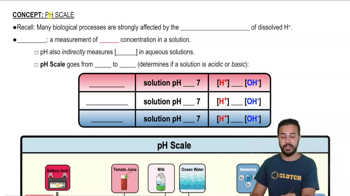
What happens to the pH of a solution when hydrogen ions are added?
a. The pH increases.
b. The pH decreases.
c. The pH does not change.
d. The pH does not measure hydrogen ion concentration.
Verified step by step guidance
Verified video answer for a similar problem:
Key Concepts
pH Scale
Hydrogen Ions (H+)
Acid-Base Reaction
A woman begins a diet and exercise regimen and loses 30 lb. Will her total body water increase, decrease, or stay the same? Why?
Ms. Johanssen is a patient in the hospital. The nurse examines her laboratory reports and notices that she has developed hyperkalemia and acidosis over the past several days. On closer examination of her medical chart, the nurse also sees that her physician recently doubled her dose of spironolactone, an aldosterone-blocking diuretic. How does this explain her laboratory findings?
Explain how the amount of water in the body affects the concentration of ions and solutes in the ECF.
Diabetic ketoacidosis is characterized by an increased level of ketone bodies, which causes metabolic acidosis. A patient in diabetic ketoacidosis will have an altered rate of ventilation. Will the patient be hyperventilating or hypoventilating? How will a change in the rate and depth of ventilation compensate for an acidosis that is metabolic in nature?
What happens to the concentration of sodium ions in the ECF if you consume a large amount of salt without consuming any water? How will this affect the osmotic pressure of the ECF? Why could this lead to an elevation in blood pressure?
