

Ch. 24 The Urinary System
Amerman- Human Anatomy & Physiology 3e
Amerman3rd EditionHuman Anatomy & PhysiologyISBN: 9780138247201, 9780138247928, 9780138201814Not the one you use?Change textbook
Chapter 24, Problem 4

Cortical and juxtamedullary nephrons differ in the:
a. Lengths of their nephron loops
b. Structure of the capillaries surrounding them
c. Structure of their renal corpuscles
d. Both a and b are correct
e. Both b and c are correct

Verified step by step guidance
1
Understand the basic anatomy of nephrons: Nephrons are the functional units of the kidney, and there are two types—cortical nephrons and juxtamedullary nephrons. Cortical nephrons are located primarily in the renal cortex, while juxtamedullary nephrons are located near the boundary of the cortex and medulla.
Analyze the differences in nephron loop lengths: Cortical nephrons have shorter nephron loops that barely extend into the medulla, whereas juxtamedullary nephrons have much longer nephron loops that extend deep into the medulla. This difference is crucial for the kidney's ability to concentrate urine.
Examine the capillary structures: Cortical nephrons are surrounded by peritubular capillaries, which are a network of capillaries that primarily function in reabsorption and secretion. Juxtamedullary nephrons, on the other hand, are surrounded by vasa recta, a specialized capillary network that plays a key role in maintaining the medullary osmotic gradient.
Evaluate the structure of renal corpuscles: Both cortical and juxtamedullary nephrons have similar renal corpuscles, which consist of the glomerulus and Bowman's capsule. There is no significant structural difference in the renal corpuscles between the two types of nephrons.
Determine the correct answer: Based on the above analysis, the differences between cortical and juxtamedullary nephrons are related to the lengths of their nephron loops and the structure of the capillaries surrounding them. Therefore, the correct answer is 'd. Both a and b are correct.'

Verified video answer for a similar problem:

This video solution was recommended by our tutors as helpful for the problem above.
Was this helpful?

Key Concepts

Here are the essential concepts you must grasp in order to answer the question correctly.

Nephron Structure

Nephrons are the functional units of the kidney, consisting of a renal corpuscle and a renal tubule. Cortical nephrons have shorter loops of Henle that primarily reside in the renal cortex, while juxtamedullary nephrons have longer loops that extend deep into the medulla. This structural difference is crucial for their respective roles in urine concentration and filtration.
Recommended video:
0:50
The Nephron Example 1

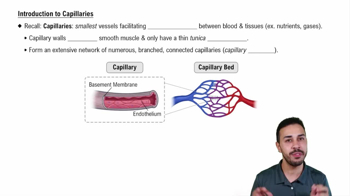
Capillary Networks

The capillary networks surrounding nephrons, specifically the glomeruli and peritubular capillaries, play a vital role in filtration and reabsorption. Cortical nephrons are associated with peritubular capillaries, which are more abundant in the cortex, while juxtamedullary nephrons are linked to the vasa recta, which are essential for maintaining the osmotic gradient in the medulla.
Recommended video:
4:36
Introduction to Capillaries

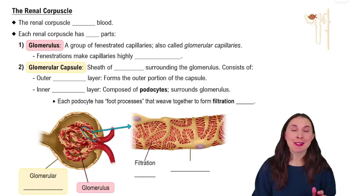
Renal Corpuscle

The renal corpuscle is the initial filtering component of the nephron, consisting of the glomerulus and Bowman's capsule. The structure of the renal corpuscle can vary between cortical and juxtamedullary nephrons, influencing their filtration efficiency and the overall function of the kidney in regulating fluid and electrolyte balance.
Recommended video:
4:52
The Renal Corpuscle