Ch. 20 The Lymphatic System and Immunity
Amerman- Human Anatomy & Physiology 3e
Amerman3rd EditionHuman Anatomy & PhysiologyISBN: 9780138247201, 9780138247928, 9780138201814Not the one you use?Change textbook
Chapter 20, Problem 3

The lymphoid organ that filters the blood is the ______, and the lymphoid organ that filters the lymph is the______.

Verified step by step guidance
1
Step 1: Understand the role of lymphoid organs in the body. Lymphoid organs are part of the immune system and are responsible for filtering and monitoring fluids in the body, such as blood and lymph, to detect and respond to pathogens.
Step 2: Recall the primary lymphoid organ responsible for filtering blood. This organ removes old or damaged red blood cells and pathogens from the bloodstream, while also serving as a site for immune responses.
Step 3: Identify the lymphoid organ responsible for filtering lymph. This organ is distributed throughout the body and acts as a checkpoint for lymphatic fluid, trapping pathogens and debris while housing immune cells to initiate a response.
Step 4: Match the descriptions to the correct organs. The organ that filters blood is the spleen, and the organ that filters lymph is the lymph node.
Step 5: Review the anatomical locations and functions of the spleen and lymph nodes to reinforce understanding. The spleen is located in the upper left abdomen, while lymph nodes are found throughout the body, especially in areas like the neck, armpits, and groin.

Verified video answer for a similar problem:

This video solution was recommended by our tutors as helpful for the problem above.
Was this helpful?

Key Concepts

Here are the essential concepts you must grasp in order to answer the question correctly.

Spleen

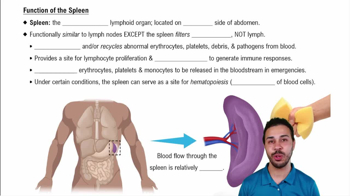
The spleen is a vital lymphoid organ responsible for filtering blood. It removes old or damaged red blood cells and pathogens, playing a crucial role in the immune response. The spleen also stores white blood cells and platelets, contributing to the body's ability to fight infections and maintain blood health.
Recommended video:
7:11
Function of the Spleen

Lymph Nodes

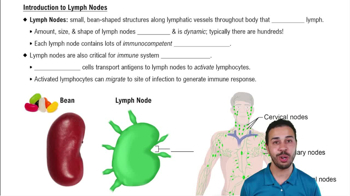
Lymph nodes are small, bean-shaped structures that filter lymph fluid as it circulates through the lymphatic system. They contain immune cells that can detect and respond to pathogens, making them essential for the body's defense mechanisms. Lymph nodes swell during infections, indicating their active role in filtering and fighting off disease.
Recommended video:
5:05
Introduction to Lymph Nodes

Lymphatic System

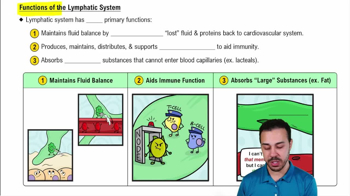
The lymphatic system is a network of vessels and organs that transport lymph, a fluid containing infection-fighting white blood cells. It plays a critical role in maintaining fluid balance in the body and is integral to the immune system. The system includes lymph nodes, the spleen, and other lymphoid tissues, facilitating the filtration of lymph and the immune response.
Recommended video:
3:57
Functions of the Lymphatic System
Related Practice
Textbook Question

Mark the following statements as true or false. If a statement is false, correct it to make a true statement.

Fat-containing lymph from the intestines drains into the cisterna chyli.

1
views

Textbook Question

Your friend tests her snake-wrangling skills on an eastern diamondback rattlesnake, and is bitten and envenomated (injected with the snake's venom). In the emergency department, doctors administer the antivenin CroFab, which contains antibodies to the toxins in snake venom. Is this an example of active or passive immunity? Will this confer any lasting protection to your friend?

1
views
Textbook Question

Carla presents to her physician with a complaint of swollen axillary lymph nodes. Her physician performs a breast exam and finds a tumor on the same side as the swollen nodes.

b. Carla undergoes surgery to have the tumor and affected lymph nodes and surrounding lymphatic vessels removed. Predict any complications Carla might have after the surgery that could arise from removal of the lymph nodes and vessels.

2
views
Textbook Question

Carla presents to her physician with a complaint of swollen axillary lymph nodes. Her physician performs a breast exam and finds a tumor on the same side as the swollen nodes.

a. Explain what process has likely caused her nodes to swell.

2
views
Textbook Question

Mark the following statements as true or false. If a statement is false, correct it to make a true statement.

The thymus is the site of maturation of B cells.

Textbook Question

Mark the following statements as true or false. If a statement is false, correct it to make a true statement.

Clusters of MALT located around the oral and nasal cavities are known as Peyer's patches.

9
views