
Ch. 19 Blood
Amerman- Human Anatomy & Physiology 3e
Amerman3rd EditionHuman Anatomy & PhysiologyISBN: 9780138247201, 9780138247928, 9780138201814Not the one you use?Change textbook
Chapter 19, Problem L3.3c

Predict the effects of each of the following on systemic arterial blood pressure:
Blood loss from a bleeding ulcer

Verified step by step guidance
1
Understand the relationship between blood volume and systemic arterial blood pressure: Blood pressure is directly influenced by blood volume. A decrease in blood volume reduces the amount of blood available to exert pressure on arterial walls.
Recognize the physiological response to blood loss: Blood loss from a bleeding ulcer leads to hypovolemia (low blood volume), which can decrease venous return to the heart and subsequently reduce cardiac output.
Analyze the role of cardiac output in blood pressure regulation: Systemic arterial blood pressure is determined by the formula: P=Q×R, where P is blood pressure, Q is cardiac output, and R is systemic vascular resistance. A decrease in cardiac output due to reduced venous return will lower blood pressure.
Consider compensatory mechanisms: The body may attempt to compensate for the drop in blood pressure through mechanisms such as vasoconstriction (narrowing of blood vessels) and increased heart rate, mediated by the sympathetic nervous system and hormones like epinephrine.
Evaluate the overall effect: If the blood loss is significant and compensatory mechanisms are insufficient, systemic arterial blood pressure will decrease, potentially leading to hypotension and shock.

Verified video answer for a similar problem:

This video solution was recommended by our tutors as helpful for the problem above.
Was this helpful?

Key Concepts

Here are the essential concepts you must grasp in order to answer the question correctly.

Blood Volume and Pressure Relationship

Blood volume is directly related to systemic arterial blood pressure; a decrease in blood volume typically leads to a drop in blood pressure. When blood is lost, such as from a bleeding ulcer, the overall volume of circulating blood decreases, which can result in hypotension, or low blood pressure.
Recommended video:
Guided course
5:46
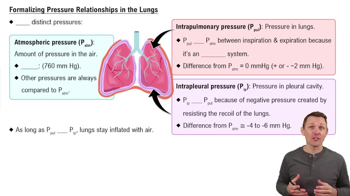
Formalizing Pressure Relationships in the Lungs

Compensatory Mechanisms

The body has several compensatory mechanisms to counteract low blood pressure, including increased heart rate and vasoconstriction. These responses are mediated by the autonomic nervous system and hormones like adrenaline, which aim to maintain adequate blood flow to vital organs despite blood loss.
Recommended video:
3:02
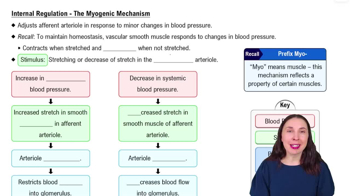
Internal Regulation - The Myogenic Mechanism

Shock and Its Stages

Shock is a critical condition that occurs when the body does not get enough blood flow, leading to inadequate oxygen delivery to tissues. In the case of significant blood loss, the body may progress through stages of shock, starting with compensatory mechanisms and potentially leading to irreversible shock if blood pressure remains low and organ perfusion is compromised.
Recommended video:
02:28
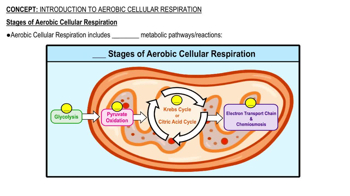
Stages of Aerobic Cellular Respiration
Related Practice