
Ch. 15 The Special Senses
Amerman- Human Anatomy & Physiology 3e
Amerman3rd EditionHuman Anatomy & PhysiologyISBN: 9780138247201, 9780138247928, 9780138201814Not the one you use?Change textbook
Chapter 15, Problem 7

Which of the following cranial nerves is not involved in the gustatory sense?
a. Vagus nerve (X)
b. Hypoglossal nerve (XII)
c. Facial nerve (VII)
d. Glossopharyngeal nerve (IX)

Verified step by step guidance
1
Understand the gustatory sense: The gustatory sense refers to the sense of taste, which involves detecting chemical stimuli on the tongue and other parts of the oral cavity. Cranial nerves involved in taste carry sensory information from taste buds to the brain.
Identify the cranial nerves associated with taste: The cranial nerves involved in the gustatory sense are the Facial nerve (VII), Glossopharyngeal nerve (IX), and Vagus nerve (X). These nerves transmit taste sensations from different regions of the tongue and oral cavity.
Review the function of the Hypoglossal nerve (XII): The Hypoglossal nerve is primarily a motor nerve responsible for controlling the movements of the tongue. It does not carry sensory information related to taste.
Compare the options: Analyze each option to determine whether the nerve is involved in the gustatory sense. The Facial nerve (VII) is responsible for taste in the anterior two-thirds of the tongue, the Glossopharyngeal nerve (IX) for the posterior one-third, and the Vagus nerve (X) for taste in the throat and epiglottis. The Hypoglossal nerve (XII) is not involved in taste.
Conclude the answer: Based on the analysis, the cranial nerve not involved in the gustatory sense is the Hypoglossal nerve (XII).

Verified video answer for a similar problem:

This video solution was recommended by our tutors as helpful for the problem above.
Was this helpful?

Key Concepts

Here are the essential concepts you must grasp in order to answer the question correctly.

Cranial Nerves

Cranial nerves are a set of twelve paired nerves that originate in the brain and primarily serve the head and neck regions. Each nerve has specific functions, including sensory, motor, or both. Understanding the roles of these nerves is crucial for identifying their involvement in various sensory modalities, including taste.
Recommended video:
Guided course
8:20
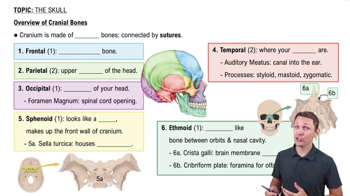
Overview of Cranial Bones

Gustatory Sense

The gustatory sense, or taste, is the sensory perception of flavor through the stimulation of taste buds located on the tongue and other areas of the oral cavity. It involves several cranial nerves that transmit taste information to the brain, allowing for the recognition of different flavors such as sweet, sour, salty, bitter, and umami.
Recommended video:
Guided course
5:05
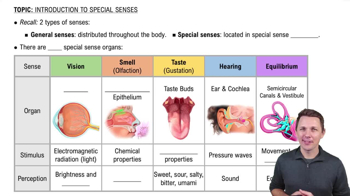
Special Senses

Cranial Nerve Functions

Each cranial nerve has distinct functions related to sensory and motor activities. For instance, the facial nerve (VII) and glossopharyngeal nerve (IX) are involved in taste sensation, while the hypoglossal nerve (XII) primarily controls tongue movements and is not directly involved in taste perception. Recognizing these functions helps in determining which nerves contribute to the gustatory sense.
Recommended video:
Guided course
8:20
Overview of Cranial Bones