A spinal nerve divides into a(n)_____ that serves the anterior side of the body and the limbs and a(n)_____that serves the posterior side of the body.
Ch. 13 The Peripheral Nervous System
Amerman3rd EditionHuman Anatomy & PhysiologyISBN: 9780138247201, 9780138247928, 9780138201814Not the one you use?Change textbook
Chapter 13, Problem 1d
Mark the following statements as true or false. If a statement is false, correct it to make a true statement.
d. The term nerve is the equivalent of the term neuron.
Verified step by step guidance1
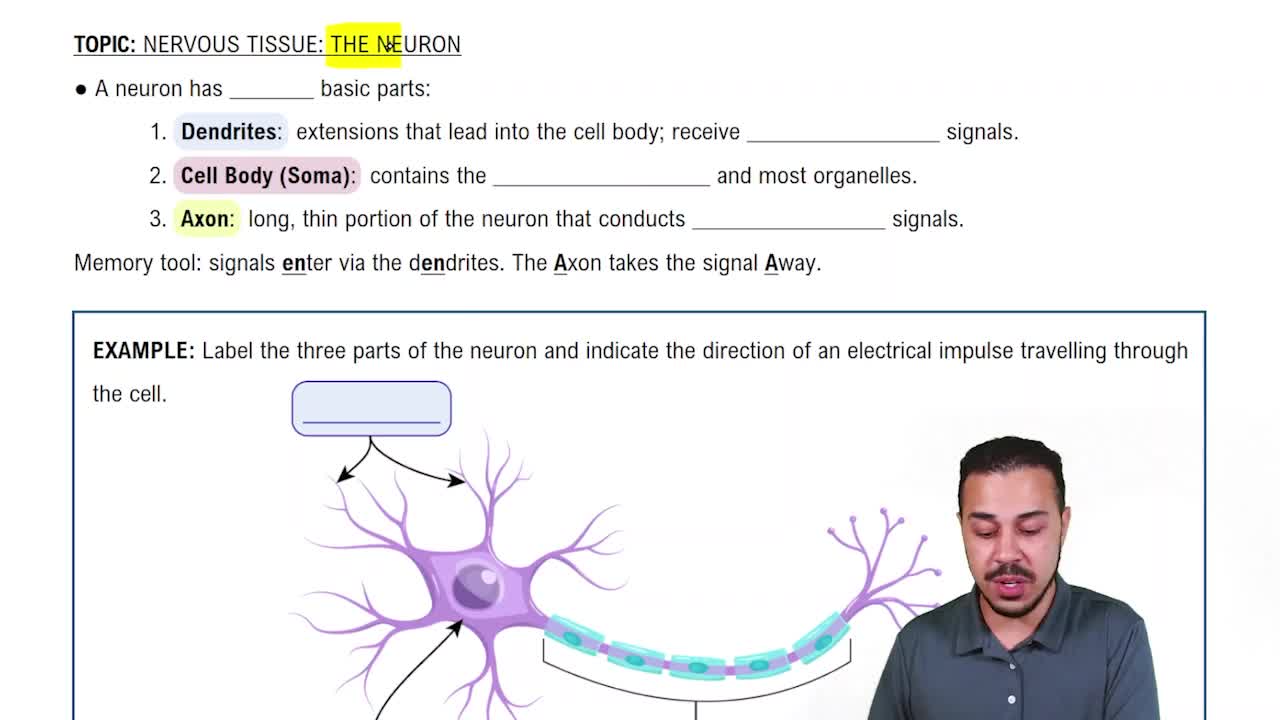
Step 1: Understand the terms 'nerve' and 'neuron'. A 'nerve' is a bundle of axons (nerve fibers) in the peripheral nervous system, surrounded by connective tissue. A 'neuron' is a single nerve cell, which includes the cell body, dendrites, and axon.
Step 2: Analyze the statement: 'The term nerve is the equivalent of the term neuron.' This implies that the two terms are interchangeable, which is incorrect based on their definitions.
Step 3: Determine the correct relationship between the terms. A nerve is composed of many neurons' axons, but it is not equivalent to a single neuron.
Step 4: Correct the false statement. The corrected statement should read: 'The term nerve is not equivalent to the term neuron. A nerve is a bundle of axons from multiple neurons in the peripheral nervous system.'
Step 5: Review the corrected statement to ensure clarity and accuracy, emphasizing the distinction between the structural and functional roles of nerves and neurons.

Verified video answer for a similar problem:
This video solution was recommended by our tutors as helpful for the problem above.
Was this helpful?
Key Concepts
Here are the essential concepts you must grasp in order to answer the question correctly.
Nerve vs. Neuron
A nerve is a bundle of axons from multiple neurons, encased in connective tissue, that transmits signals between the central nervous system and the rest of the body. In contrast, a neuron is a single nerve cell that is responsible for transmitting information through electrical and chemical signals. Thus, the statement is false because a nerve comprises many neurons, not just one.
Recommended video:
Guided course
The Neuron
Structure of the Nervous System
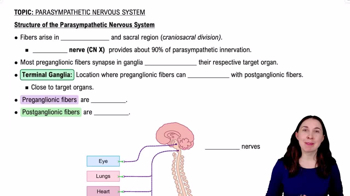
The nervous system is divided into the central nervous system (CNS) and the peripheral nervous system (PNS). The CNS includes the brain and spinal cord, while the PNS consists of all the nerves that branch out from the CNS to the rest of the body. Understanding this structure is essential for distinguishing between individual neurons and the larger nerve structures they form.
Recommended video:
Structure of the Parasympathetic Nervous System
Function of Neurons
Neurons are specialized cells that transmit information throughout the body via electrical impulses and neurotransmitter release. They play a critical role in processing and communicating signals, enabling functions such as reflexes, sensory perception, and motor control. Recognizing the function of neurons helps clarify their role within nerves and the broader nervous system.
Recommended video:
Guided course
The Neuron
Related Practice
Textbook Question
1
views
Textbook Question
Mark the following statements as true or false. If a statement is false, correct it to make a true statement.
a. The somatic sensory division of the PNS detects sensory stimuli from the organs in the thoracic and abdominopelvic cavities.
1
views
Textbook Question
Mark the following statements as true or false. If a statement is false, correct it to make a true statement.
b. The somatic motor division of the PNS consists of lower motor neurons that directly innervate skeletal muscle fibers.
1
views
Textbook Question
Mark the following statements as true or false. If a statement is false, correct it to make a true statement.
e. There are 31 pairs of spinal nerves and 12 pairs of cranial nerves.
Textbook Question
Devise a series of physical examination tests that assess the function of each of the cranial nerves.
8
views