Ch. 13 The Peripheral Nervous System
Amerman- Human Anatomy & Physiology 3e
Amerman3rd EditionHuman Anatomy & PhysiologyISBN: 9780138247201, 9780138247928, 9780138201814Not the one you use?Change textbook
Chapter 13, Problem 15

The cell bodies of upper motor neurons reside in the ________ and function to ________, whereas the cell bodies of lower motor neurons reside in the ________ and function to ________.

Verified step by step guidance
1
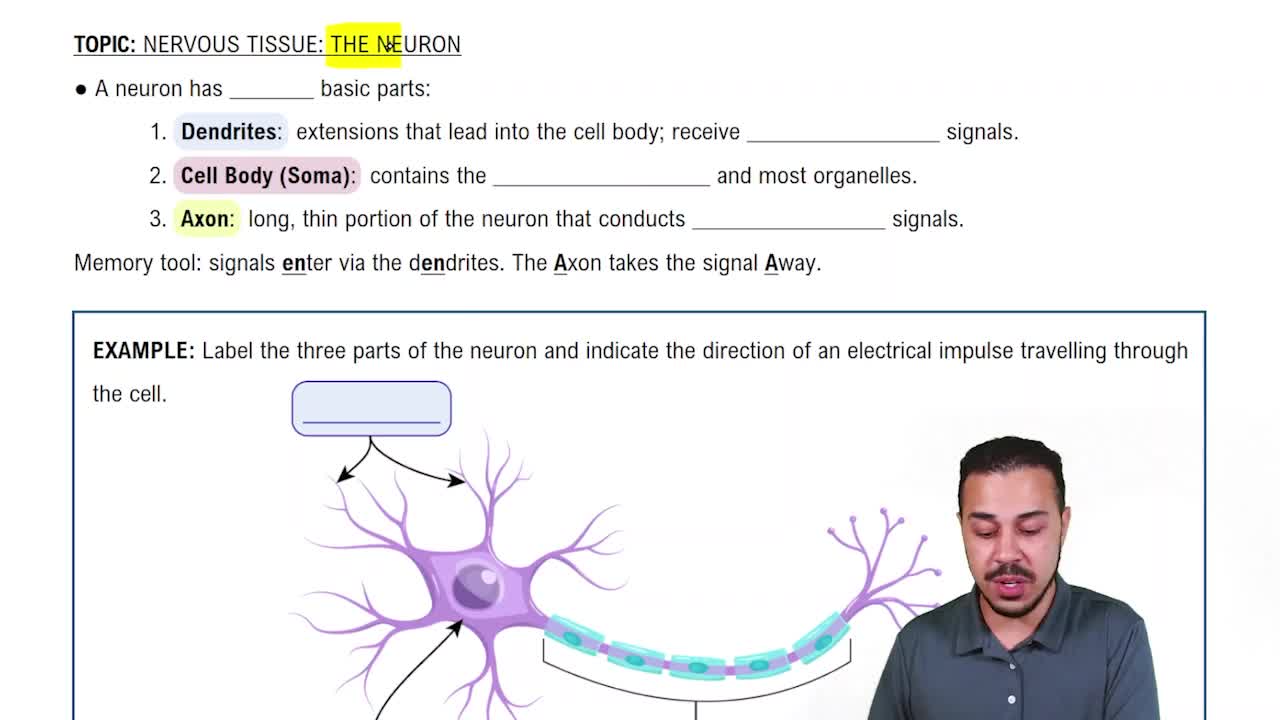
Step 1: Understand the distinction between upper motor neurons and lower motor neurons. Upper motor neurons are part of the central nervous system (CNS), while lower motor neurons are part of the peripheral nervous system (PNS).
Step 2: Identify the location of the cell bodies of upper motor neurons. These are found in the motor cortex of the brain, specifically in the precentral gyrus of the frontal lobe.
Step 3: Determine the function of upper motor neurons. They are responsible for initiating and controlling voluntary movements by sending signals to lower motor neurons.
Step 4: Identify the location of the cell bodies of lower motor neurons. These are found in the anterior horn of the spinal cord or in cranial nerve nuclei within the brainstem.
Step 5: Determine the function of lower motor neurons. They directly innervate skeletal muscles and are responsible for executing the movement commands received from upper motor neurons.

Verified video answer for a similar problem:

This video solution was recommended by our tutors as helpful for the problem above.
Was this helpful?

Key Concepts

Here are the essential concepts you must grasp in order to answer the question correctly.

Upper Motor Neurons

Upper motor neurons are located in the brain, primarily in the motor cortex, and are responsible for initiating and controlling voluntary movements. They send signals down the spinal cord to lower motor neurons, facilitating communication between the brain and the muscles. Dysfunction in upper motor neurons can lead to conditions such as spasticity and weakness.
Recommended video:

Lower Motor Neurons

Lower motor neurons are found in the spinal cord and brainstem, where they directly innervate skeletal muscles. They receive signals from upper motor neurons and transmit these signals to muscles, resulting in contraction and movement. Damage to lower motor neurons can lead to muscle atrophy and flaccid paralysis.
Recommended video:

Motor Pathways

Motor pathways consist of the neural circuits that connect upper and lower motor neurons, facilitating the transmission of motor commands from the brain to the muscles. These pathways include the corticospinal tract for voluntary movements and other pathways for reflex actions. Understanding these pathways is crucial for diagnosing and treating motor disorders.
Recommended video:
4:40
Alternative Pathway
Related Practice
Textbook Question

The lower motor neurons that innervate contractile skeletal muscle fibers are called:

a. α-motor neurons

b. β-motor neurons

c. upper motor neurons

d. γ-motor neurons
Textbook Question

______detect the degree to which a muscle is stretched, whereas______detect the force of a muscle contraction.

2
views
Textbook Question

Which of the following is the correct order of events of a reflex arc?


a. Stimulus detection and delivery → motor response → integration in the CNS

b. Motor response → stimulus detection and delivery → integration in the CNS

c. Stimulus detection and delivery → integration in the CNS → delivery of motor response

d. Integration in the CNS → motor response → stimulus detection and delivery

1
views
Textbook Question

Which parts of the body have the greatest amount of space dedicated to them in the primary somatosensory cortex? Why?

3
views
Textbook Question

Which of the following statements is false?

a. The spinothalamic tracts are part of the anterolateral system.

b. Pain, temperature, and crude touch stimuli are carried by the anterolateral system.

c. Descending pathways from the brain and spinal cord can make the spinal cord less receptive to pain stimuli.

d. The thalamus serves as the 'gateway' for entry of all special sensory stimuli into the cerebral cortex, with the exception of audition (hearing).

2
views
Textbook Question

Label the following components of the corticospinal tracts with numbers 1 through 6, with 1 being the origin of the tracts and 6 their destination.     

_____ Medullary pyramids where most fibers decussate.     

_____ Anterior horn of the spinal gray matter.     

_____ Midbrain and pons.      

_____ Upper motor neurons in the primary motor and premotor cortices.     

_____ Corona radiata and internal capsule.        

_____ Lateral funiculus of the spinal cord.

1
views