
Ch. 1 Introduction to Anatomy and Physiology
Amerman- Human Anatomy & Physiology 3e
Amerman3rd EditionHuman Anatomy & PhysiologyISBN: 9780138247201, 9780138247928, 9780138201814Not the one you use?Change textbook
Chapter 1, Problem 4

Groups of many cells working together to perform a common function are known as a(n):
a. Cell
b. Organ
c. Organ system
d. Tissue

Verified step by step guidance
1
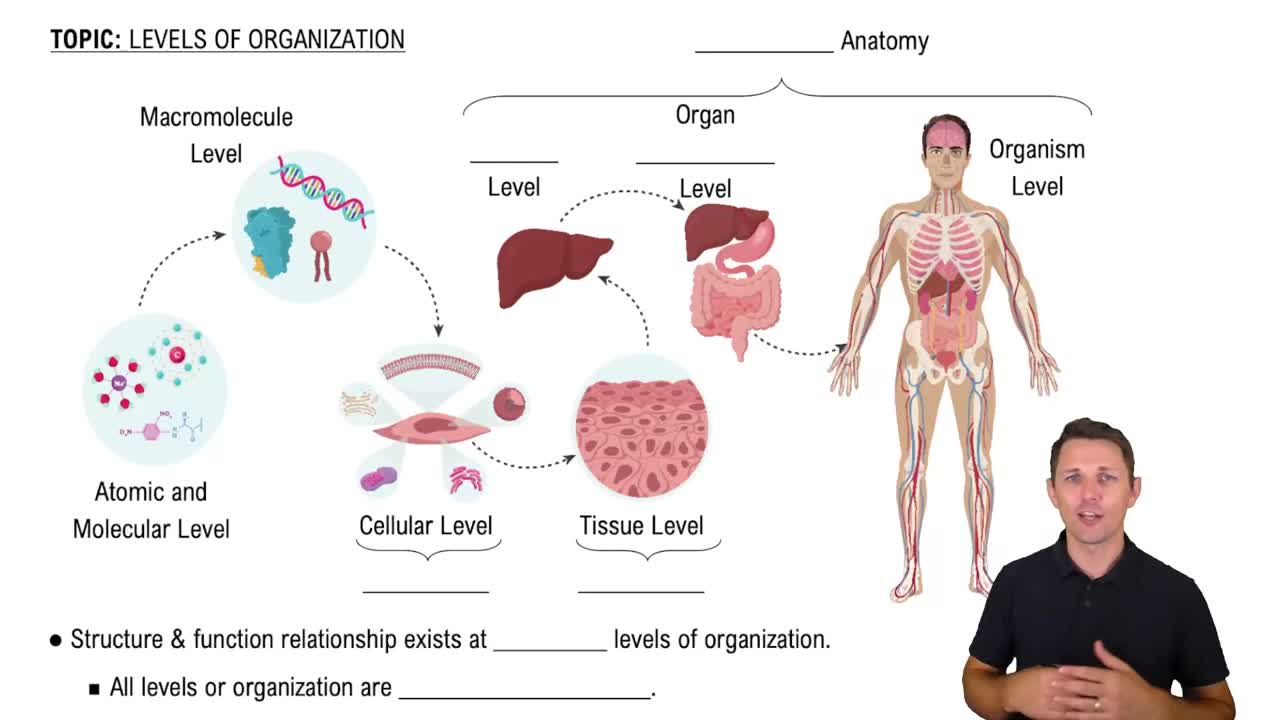
Step 1: Understand the hierarchy of biological organization in the human body. The levels of organization include cells, tissues, organs, organ systems, and the organism as a whole.
Step 2: Recall the definition of a tissue. A tissue is a group of similar cells that work together to perform a specific function. Examples include muscle tissue, nervous tissue, and epithelial tissue.
Step 3: Differentiate between the other options: a cell is the basic unit of life, an organ is a structure made up of multiple tissues working together, and an organ system is a group of organs that perform a collective function.
Step 4: Match the definition provided in the question ('groups of many cells working together to perform a common function') with the correct term from the options.
Step 5: Conclude that the correct answer is the term that aligns with the definition of a tissue, as it fits the description provided in the question.

Verified video answer for a similar problem:

This video solution was recommended by our tutors as helpful for the problem above.
Was this helpful?

Key Concepts

Here are the essential concepts you must grasp in order to answer the question correctly.

Cell

A cell is the basic structural and functional unit of all living organisms. Cells can exist as independent entities, such as bacteria, or as part of multicellular organisms, where they perform specialized functions. Understanding cells is fundamental to biology, as they are the building blocks of life.
Recommended video:
05:33
Cell Junctions

Tissue

Tissue is a group of similar cells that work together to perform a specific function. In multicellular organisms, tissues are organized into four main types: epithelial, connective, muscle, and nervous tissue. Each type has distinct roles, such as protection, support, movement, and communication.
Recommended video:
4:55
Lymphoid Tissue

Organ

An organ is a structure composed of two or more types of tissues that work together to perform specific functions within an organism. Examples include the heart, lungs, and liver. Organs are part of organ systems, which coordinate complex functions necessary for survival.
Recommended video:
Guided course
05:04
The Levels of Organization
Related Practice
Textbook Question

Mark the following statements as true or false. If a statement is false, correct it to make a true statement.

The anatomical position features the person facing forward, feet shoulder-width apart, and palms facing posteriorly.

6
views
Textbook Question

Match the following terms with the correct definition.

Anterior: -----------a. Toward the back

Lateral:------------b. Closer to the midline      

Proximal: ----------c. Farther away from the point of origin      

Posterior:----------d. Toward the front    

Inferior:------------e. Closer to the point of origin

Distal:------------- f. Toward the head

Medial: -----------g. Away from the body's midline

Superior:----------- h. Toward the tail 

4
views
Textbook Question

The baroreceptor reflex causes blood pressure to drop when it rises dangerously high. Predict whether this is a positive or negative feedback loop. Explain your reasoning.

4
views
Textbook Question

Ms. Norman presents to the clinic with right upper quadrant pain. Predict the organs and cavities that may be involved in causing her pain.

3
views
Textbook Question

Later that same day, the surgeon performs a procedure on Ms. Norman's right kidney. She makes the incision in the right posterior lumbar region. Will she cut through the same serous membrane(s) and cavities as in the previous procedure? Why or why not? How would this change if the incision were made on the anterior lumbar region?

2
views
Textbook Question

Mark the following statements as true or false. If a statement is false, correct it to make a true statement.

Living organisms react to changes in their environment known as stimuli.

5
views