Ch. 1 Introduction to Anatomy and Physiology
Amerman- Human Anatomy & Physiology 3e
Amerman3rd EditionHuman Anatomy & PhysiologyISBN: 9780138247201, 9780138247928, 9780138201814Not the one you use?Change textbook
Chapter 1, Problem 11

The two divisions of the posterior body cavity are the _____ and______ body cavities.

Verified step by step guidance
1
Understand that the posterior body cavity, also known as the dorsal body cavity, is one of the main body cavities in the human body and houses structures of the central nervous system.
Recall that the posterior body cavity is divided into two smaller cavities: one that contains the brain and another that contains the spinal cord.
Identify that the cavity housing the brain is called the cranial cavity, which is located within the skull and protects the brain.
Recognize that the cavity housing the spinal cord is called the vertebral (or spinal) cavity, which runs within the vertebral column and protects the spinal cord.
Combine this information to conclude that the two divisions of the posterior body cavity are the cranial cavity and the vertebral (spinal) cavity.

Verified video answer for a similar problem:

This video solution was recommended by our tutors as helpful for the problem above.
Was this helpful?

Key Concepts

Here are the essential concepts you must grasp in order to answer the question correctly.

Posterior Body Cavity

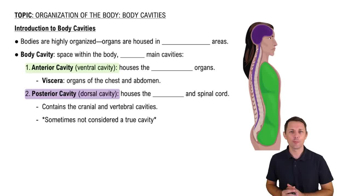
The posterior body cavity, also known as the dorsal cavity, is one of the two main body cavities in vertebrates. It is divided into two sub-cavities: the cranial cavity, which houses the brain, and the vertebral cavity, which contains the spinal cord. Understanding this division is crucial for studying the organization of the body's internal structures.
Recommended video:
Guided course
3:20
Introduction to Body Cavities

Cranial Cavity

The cranial cavity is the upper part of the posterior body cavity, encased by the skull. It protects the brain and provides a supportive environment for its functions. Knowledge of the cranial cavity is essential for understanding neurological anatomy and the relationship between the brain and surrounding structures.
Recommended video:
Guided course
3:20
Introduction to Body Cavities

Vertebral Cavity

The vertebral cavity, also known as the spinal cavity, is the lower part of the posterior body cavity that surrounds and protects the spinal cord. It is formed by the vertebrae of the spine and plays a critical role in the central nervous system's function. Familiarity with the vertebral cavity is important for comprehending spinal anatomy and related medical conditions.
Recommended video:
Guided course
3:20
Introduction to Body Cavities