Ch. 9 The Muscular System
Amerman - Human Anatomy & Physiology 2nd Edition
Amerman2nd EditionHuman Anatomy & PhysiologyISBN: 9780136873822Not the one you use?Change textbook
Chapter 9, Problem 16

Match the muscle with its main action:
____Vastus medius muscle     
____Gracilis muscle     
____Gluteus medius muscle     
____Gastrocnemius muscle     
____Biceps femoris muscle     
____Tibialis anterior muscle
a. Adducts thigh
b. Extends thigh and flexes leg
c. Plantarflexes foot
d. Abducts thigh
e. Dorsiflexes foot
f. Extends leg

Verified step by step guidance
1
Step 1: Understand the main actions of each muscle listed in the problem. For example, the Vastus medius muscle is part of the quadriceps group and is primarily responsible for extending the leg at the knee joint.
Step 2: Match the Gracilis muscle with its action. The Gracilis is a medial thigh muscle that primarily adducts the thigh, pulling it toward the midline.
Step 3: Identify the Gluteus medius muscle's action. This muscle is located in the hip region and is responsible for abducting the thigh, moving it away from the midline.
Step 4: Determine the action of the Gastrocnemius muscle. This calf muscle is involved in plantarflexion of the foot, which points the toes downward.
Step 5: Match the Biceps femoris muscle and Tibialis anterior muscle with their actions. The Biceps femoris extends the thigh and flexes the leg, while the Tibialis anterior dorsiflexes the foot, pulling the toes upward.

Verified video answer for a similar problem:

This video solution was recommended by our tutors as helpful for the problem above.
Was this helpful?

Key Concepts

Here are the essential concepts you must grasp in order to answer the question correctly.

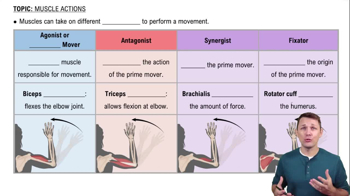
Muscle Actions

Muscle actions refer to the specific movements that muscles facilitate when they contract. Understanding the primary actions of different muscles is crucial for identifying their roles in movement. For example, the gastrocnemius muscle primarily plantarflexes the foot, while the biceps femoris extends the thigh and flexes the leg.
Recommended video:
Guided course
5:41
Muscle Actions

Muscle Anatomy

Muscle anatomy involves the study of the structure and location of muscles in the body. Each muscle has a unique position and attachment points that determine its function. For instance, the gluteus medius is located on the lateral side of the hip and is responsible for thigh abduction.
Recommended video:
Guided course
2:00
Introduction to Muscles and Muscle Tissue Example 1

Functional Groups of Muscles

Muscles can be categorized into functional groups based on their actions during movement. These groups include flexors, extensors, abductors, and adductors. Recognizing these groups helps in understanding how different muscles work together to produce coordinated movements, such as how the gracilis adducts the thigh.
Recommended video:
06:04
Functional Groups