Ch. 7 The Skeletal System
Amerman - Human Anatomy & Physiology 2nd Edition
Amerman2nd EditionHuman Anatomy & PhysiologyISBN: 9780136873822Not the one you use?Change textbook
Chapter 7, Problem L3.1

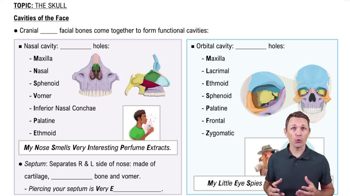
A deviated septum results when the nasal septum is shifted to one side or the other. What bones might be involved in this condition? Why might this make breathing difficult?

Verified step by step guidance
1
Understand the anatomy of the nasal septum: The nasal septum is a structure that divides the nasal cavity into two halves. It is composed of both bone and cartilage. The bony components include the perpendicular plate of the ethmoid bone and the vomer bone, while the cartilaginous portion is made of hyaline cartilage.
Identify the bones potentially involved in a deviated septum: A deviation can occur due to displacement or malformation of the perpendicular plate of the ethmoid bone or the vomer bone. Trauma or congenital conditions may cause these bones to shift, leading to the deviation.
Explain how a deviated septum affects airflow: A deviation can obstruct one or both nasal passages, reducing the space available for air to flow. This can lead to difficulty breathing, especially during physical activity or while sleeping.
Discuss the physiological consequences of reduced airflow: When airflow is restricted, it can lead to symptoms such as nasal congestion, snoring, or sleep apnea. Reduced oxygen intake may also affect overall respiratory efficiency.
Consider treatment options: Treatments for a deviated septum may include surgical intervention, such as septoplasty, to realign the nasal septum and restore proper airflow. Non-surgical options like nasal strips or decongestants may provide temporary relief but do not address the underlying structural issue.

Verified video answer for a similar problem:

This video solution was recommended by our tutors as helpful for the problem above.
Was this helpful?

Key Concepts

Here are the essential concepts you must grasp in order to answer the question correctly.

Nasal Septum Anatomy

The nasal septum is a structure made up of bone and cartilage that divides the nasal cavity into two nostrils. It consists primarily of the perpendicular plate of the ethmoid bone, the vomer bone, and the septal cartilage. Understanding its anatomy is crucial for recognizing how deviations can occur and their potential impact on airflow.
Recommended video:
4:14
Clitoral Anatomy

Deviated Septum

A deviated septum occurs when the nasal septum is displaced from the center, often due to congenital factors or injury. This misalignment can lead to one nasal passage being smaller than the other, which can obstruct airflow and cause difficulty in breathing, especially during physical exertion or when experiencing allergies.
Recommended video:
Guided course
6:30
Cavities of the Face

Impact on Breathing

Breathing difficulties associated with a deviated septum arise from the obstruction of airflow through the nasal passages. This can lead to symptoms such as nasal congestion, sinus infections, and sleep apnea. Understanding the physiological implications of a deviated septum helps in recognizing the need for potential medical or surgical interventions.
Recommended video:
02:29
Mutations
Related Practice
Textbook Question

Predict where each of the following structures is located, based on your knowledge of skeletal anatomy and anatomical terms (your answers should be along the lines of 'lateral crural region' or 'posterior cervical region').


a. Frontal lobe of brain

b. Suprahyoid muscle

c. Ulnar artery

d. Tibial nerve

e. Intercostal muscle

f. External iliac artery

1
views
Textbook Question

Ms. Hendrix suffered a severe hip fracture that required hip replacement surgery. After an extended recovery period, she is undergoing physical therapy to regain strength and mobility.

Which bone is involved in a hip fracture, and what part of the bone is likely to be fractured?

2
views
Textbook Question

The two parietal bones are united at the_______suture; they meet the frontal bone at the_____ suture, the temporal bones at the______ sutures, and the occipital bone at the_____suture.

3
views
Textbook Question

Some health practitioners claim that the cranial bones are moveable and that they are able to move these bones to treat a variety of conditions. Is this likely to be true in an adult? Why or why not?

1
views
Textbook Question

Mrs. Dent presents to the clinic with back pain. During the exam, you notice that she has severe kyphosis, and you suspect a vertebral fracture. What specific part of her vertebra is likely to be fractured, considering her deformity? Explain.

2
views
Textbook Question

You arrive on the scene where a person without a pulse was found. Someone on the scene performed CPR, but the individual unfortunately could not be revived. On postmortem examination, it is discovered that several ribs and the xiphoid process were fractured. What likely caused these fractures?

4
views