Ch. 3 The Cell
Amerman - Human Anatomy & Physiology 2nd Edition
Amerman2nd EditionHuman Anatomy & PhysiologyISBN: 9780136873822Not the one you use?Change textbook
Chapter 3, Problem 20

Match the following terms with the correct definitions. 
G1     
Metaphase     
S phase     
Cytokinesis 
Telophase
M phase
G2 
Anaphase
a. Division of the cytoplasm
b. Second growth stage of the cell cycle
c. Stage of the cell cycle in which the cell divides
d. Stage of mitosis in which the sister chromatids line up on the cell's equator
e. Stage of the cell cycle in which DNA is replicated
f. Stage of mitosis in which the chromosomes move to opposite poles of the cell
g. Initial growth phase of the cell cycle
h. Stage of mitosis in which the nuclear envelopes reassemble 

Verified step by step guidance
1
Step 1: Understand the terms provided in the problem. These include G1, Metaphase, S phase, Cytokinesis, Telophase, M phase, G2, and Anaphase. Each term corresponds to a specific stage or process in the cell cycle or mitosis.
Step 2: Review the definitions provided (a through h). Each definition describes a specific event or characteristic of the cell cycle or mitosis. For example, 'Division of the cytoplasm' refers to Cytokinesis, and 'Stage of the cell cycle in which DNA is replicated' refers to the S phase.
Step 3: Match each term with its corresponding definition based on your knowledge of the cell cycle and mitosis. For instance, G1 is the initial growth phase of the cell cycle, and Metaphase is the stage of mitosis where sister chromatids line up on the cell's equator.
Step 4: Use process of elimination to ensure each term is matched correctly. For example, if Telophase is the stage of mitosis where nuclear envelopes reassemble, then it cannot correspond to any other definition.
Step 5: Double-check your matches by reviewing the characteristics of each stage or process in the cell cycle and mitosis. Ensure that each term aligns with its definition logically and scientifically.

Verified video answer for a similar problem:

This video solution was recommended by our tutors as helpful for the problem above.
Was this helpful?

Key Concepts

Here are the essential concepts you must grasp in order to answer the question correctly.

Cell Cycle

The cell cycle is a series of phases that a cell goes through to grow and divide. It consists of interphase (G1, S, G2) and the mitotic phase (M phase), which includes mitosis and cytokinesis. Understanding the cell cycle is crucial for grasping how cells replicate and maintain their functions.
Recommended video:
03:31
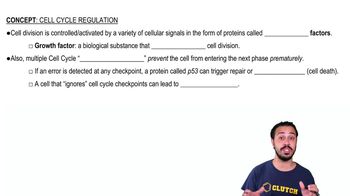
Cell Cycle Regulation

Mitosis

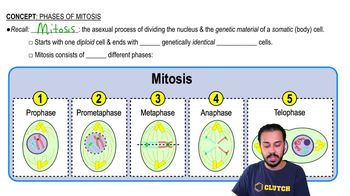
Mitosis is the process of cell division that results in two genetically identical daughter cells. It is divided into several stages: prophase, metaphase, anaphase, and telophase. Each stage has specific events, such as chromosome alignment and separation, which are essential for accurate cell division.
Recommended video:
03:21
Phases of Mitosis

Cytokinesis

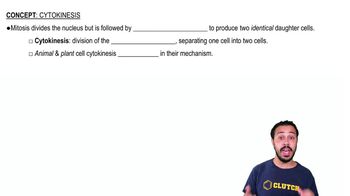
Cytokinesis is the final step of cell division, occurring after mitosis, where the cytoplasm of a parental cell is divided into two daughter cells. This process ensures that each daughter cell receives the necessary organelles and cytoplasmic components. It is crucial for the completion of the cell cycle and the formation of two distinct cells.
Recommended video:
01:25
Cytokinesis