Ch. 25 Fluid, Electrolyte, and Acid-Base Homeostasis
Amerman - Human Anatomy & Physiology 2nd Edition
Amerman2nd EditionHuman Anatomy & PhysiologyISBN: 9780136873822Not the one you use?Change textbook
Chapter 25, Problem 7

Which of the following is false with respect to sodium ions in human physiology?
a. Sodium ions are the most abundant extracellular cation.
b. Sodium ions are an important osmotic particle in the ECF.
c. The entry of sodium ions into a cell causes depolarization.
d. Sodium ions are more concentrated in the cytosol than in the ECF.

Verified step by step guidance
1
Step 1: Understand the role of sodium ions (Na⁺) in human physiology. Sodium ions are crucial for maintaining osmotic balance, nerve impulse transmission, and muscle contraction. They are primarily found in the extracellular fluid (ECF).
Step 2: Analyze option (a): 'Sodium ions are the most abundant extracellular cation.' Recall that sodium ions are indeed the most abundant cation in the ECF, contributing significantly to osmotic pressure. This statement is true.
Step 3: Analyze option (b): 'Sodium ions are an important osmotic particle in the ECF.' Sodium ions play a key role in regulating water movement between compartments due to their osmotic properties. This statement is also true.
Step 4: Analyze option (c): 'The entry of sodium ions into a cell causes depolarization.' During an action potential, sodium ions enter the cell, reducing the membrane potential and causing depolarization. This statement is true.
Step 5: Analyze option (d): 'Sodium ions are more concentrated in the cytosol than in the ECF.' Sodium ions are actually more concentrated in the ECF than in the cytosol due to the action of the sodium-potassium pump. This statement is false, making it the correct answer to the question.

Verified video answer for a similar problem:

This video solution was recommended by our tutors as helpful for the problem above.
Was this helpful?

Key Concepts

Here are the essential concepts you must grasp in order to answer the question correctly.

Sodium Ion Concentration

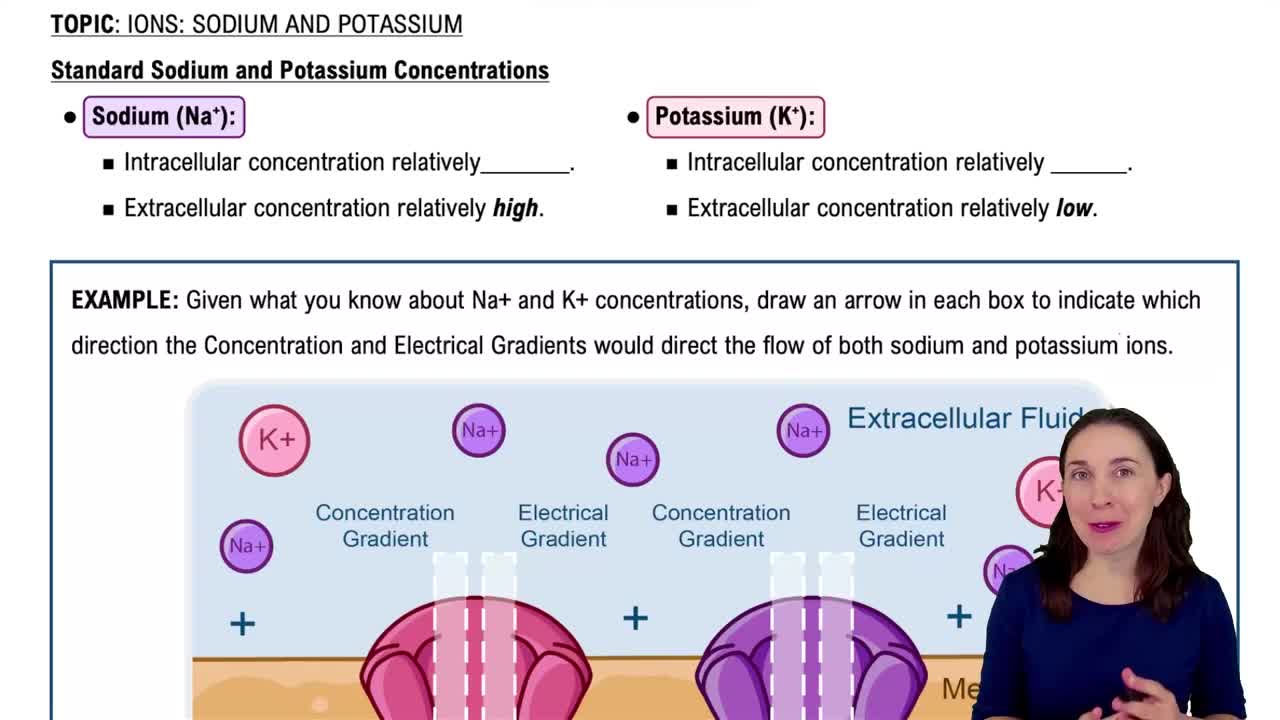
Sodium ions (Na+) are primarily found in the extracellular fluid (ECF) of the body, where they are the most abundant cation. This high concentration in the ECF is crucial for maintaining osmotic balance and proper cellular function. In contrast, sodium levels are significantly lower in the cytosol, which is essential for the generation of action potentials in neurons and muscle cells.
Recommended video:
03:35
Standard Sodium and Potassium Concentrations

Osmotic Pressure

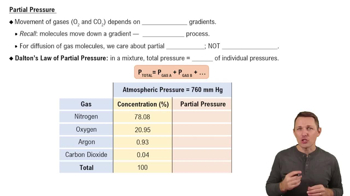
Osmotic pressure is the force exerted by solutes, such as sodium ions, that influences the movement of water across cell membranes. Sodium ions play a vital role as osmotic particles in the ECF, helping to regulate fluid balance and blood pressure. Their concentration gradient across the cell membrane is critical for various physiological processes, including nutrient absorption and waste removal.
Recommended video:
Guided course
6:12
Partial Pressure

Depolarization

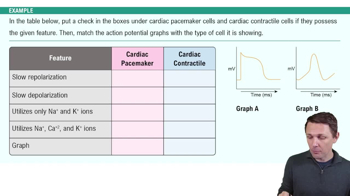
Depolarization refers to the change in membrane potential that occurs when sodium ions enter a cell, making the inside of the cell more positive. This process is essential for the initiation and propagation of action potentials in neurons and muscle cells. Understanding depolarization is key to grasping how signals are transmitted in the nervous system and how muscles contract.
Recommended video:
Guided course
3:49
Cardiac Action Potentials Example 1