
Textbook Question
Leukocytes are:
a. Nucleated cells that function in blood clotting
b. Nucleated cells that function in immunity
c. Anucleate cells that function in blood clotting
d. Anucleate cells that function in immunity
1
views

 Verified step by step guidance
 05:33
05:33
 6:31
6:31 7:11
7:11Leukocytes are:
a. Nucleated cells that function in blood clotting
b. Nucleated cells that function in immunity
c. Anucleate cells that function in blood clotting
d. Anucleate cells that function in immunity
Match the following leukocytes with the correct definition.
__Basophil
__B lymphocyte
__Neutrophil
__Monocyte
__T lymphocyte
__Eosinophil
a. Destroys bacteria; directly phagocytoses bacteria
b. Responds to parasitic worm infection and mediates the allergic response
c. Activates all parts of the immune response; directly kills cancer or virally infected cells
d. Secretes inflammatory mediators
e. Agranulocyte that matures into macrophage
f. Agranulocyte that secretes antibodies
Mark the following statements as true or false. If a statement is false, correct it to make a true statement.
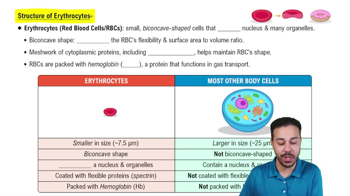
Hemoglobin forms oxyhemoglobin when it binds to oxygen.
Erythropoiesis requires stimulation from the hormone:
a. Thrombin
b. Thrombopoietin
c. Thymosin
d. Erythropoietin
Anemia is defined as:
a. A decreased oxygen-carrying capacity of the blood.
b. A decreased iron content of the blood.
c. Decreased bone marrow function.
d. Abnormalities in hemoglobin.
Mark the following statements as true or false. If a statement is false, correct it to make a true statement.
Hemoglobin consists of two polypeptide chains bound to a heme group.