Ch. 16 The Endocrine System
Amerman - Human Anatomy & Physiology 2nd Edition
Amerman2nd EditionHuman Anatomy & PhysiologyISBN: 9780136873822Not the one you use?Change textbook
Chapter 16, Problem 10

A rise in free T3 and T4 would be expected to produce a(n) ______ in TRH and TSH secretion. A decrease in free T3 and T4 would be expected to produce a(n) _____ a(n)_____in TRH and TSH secretion.

Verified step by step guidance
1
Understand the role of T3 (triiodothyronine) and T4 (thyroxine) in the endocrine system. These thyroid hormones regulate metabolism and are controlled by a feedback loop involving TRH (thyrotropin-releasing hormone) and TSH (thyroid-stimulating hormone).
Recognize the negative feedback mechanism: When levels of T3 and T4 rise, they inhibit the secretion of TRH from the hypothalamus and TSH from the anterior pituitary gland to prevent overproduction of thyroid hormones.
Analyze the first part of the problem: A rise in free T3 and T4 would suppress TRH and TSH secretion due to the negative feedback loop. This helps maintain hormonal balance.
Consider the second part of the problem: A decrease in free T3 and T4 would remove the inhibitory effect on TRH and TSH secretion, leading to an increase in their production to stimulate the thyroid gland to produce more T3 and T4.
Summarize the relationship: High levels of T3 and T4 decrease TRH and TSH secretion, while low levels of T3 and T4 increase TRH and TSH secretion, maintaining homeostasis in the endocrine system.

Verified video answer for a similar problem:

This video solution was recommended by our tutors as helpful for the problem above.
Was this helpful?

Key Concepts

Here are the essential concepts you must grasp in order to answer the question correctly.

Thyroid Hormones (T3 and T4)

Thyroid hormones, primarily triiodothyronine (T3) and thyroxine (T4), are crucial for regulating metabolism, growth, and development. They are produced by the thyroid gland and influence various physiological processes. An increase in free T3 and T4 levels typically signals the body to reduce the production of Thyrotropin-Releasing Hormone (TRH) and Thyroid-Stimulating Hormone (TSH) to maintain hormonal balance.
Recommended video:
Guided course
13:06
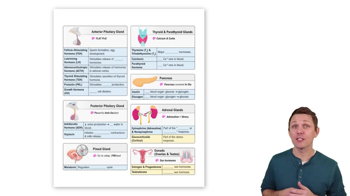
Review of Major Hormones

Feedback Mechanism

The feedback mechanism is a regulatory process in which the output of a system influences its own production. In the context of thyroid hormones, high levels of T3 and T4 inhibit the secretion of TRH from the hypothalamus and TSH from the pituitary gland, while low levels of these hormones stimulate their production. This negative feedback loop is essential for maintaining homeostasis in the endocrine system.
Recommended video:
Guided course
02:43
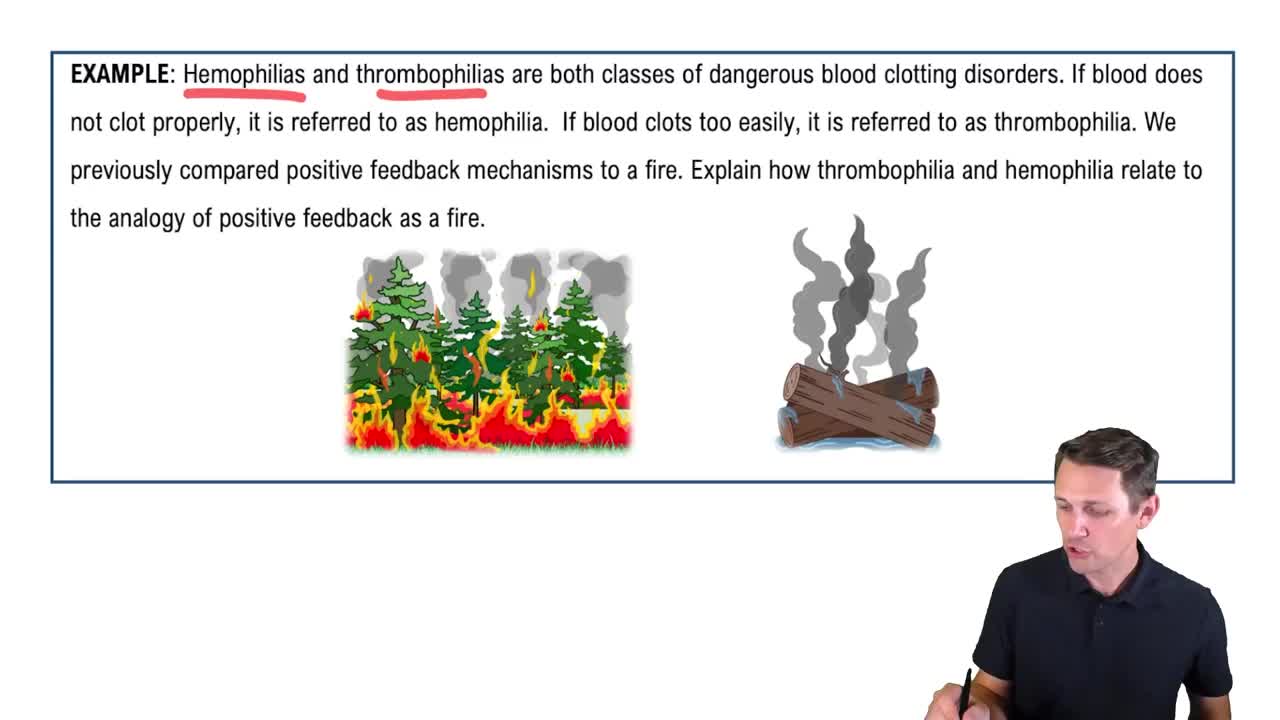
Feedback Loops: Positive Feedback Example 1

TRH and TSH

Thyrotropin-Releasing Hormone (TRH) is produced by the hypothalamus and stimulates the anterior pituitary gland to release Thyroid-Stimulating Hormone (TSH). TSH then prompts the thyroid gland to produce T3 and T4. Understanding the roles of TRH and TSH is vital for comprehending how the body regulates thyroid hormone levels and responds to changes in their concentrations.
Recommended video:
Guided course
10:02
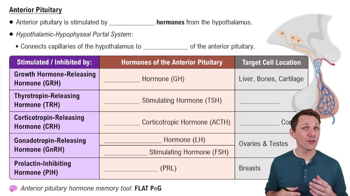
Anterior Pituitary