Ch. 15 The Special Senses
Amerman - Human Anatomy & Physiology 2nd Edition
Amerman2nd EditionHuman Anatomy & PhysiologyISBN: 9780136873822Not the one you use?Change textbook
Chapter 15, Problem 18

Mark True or false
Hair cells in the spiral organ will depolarize or hyperpolarize, depending on the direction in which the stereocilia are bent.

Verified step by step guidance
1
Understand the structure and function of hair cells in the spiral organ (organ of Corti). Hair cells are sensory receptors located in the cochlea of the inner ear, responsible for detecting sound vibrations.
Learn about stereocilia, which are small, hair-like projections on the surface of hair cells. These structures are mechanically sensitive and play a key role in the transduction of sound waves into electrical signals.
Recognize that the bending of stereocilia is caused by sound-induced vibrations in the basilar membrane. The direction of bending determines whether ion channels in the hair cell membrane open or close.
When stereocilia bend toward the tallest stereocilium, mechanically gated ion channels open, allowing potassium (K⁺) and calcium (Ca²⁺) ions to enter the cell. This leads to depolarization of the hair cell, initiating the release of neurotransmitters to the auditory nerve.
Conversely, when stereocilia bend away from the tallest stereocilium, the ion channels close, reducing ion influx and causing hyperpolarization of the hair cell. This inhibits neurotransmitter release and decreases auditory nerve activity.

Verified video answer for a similar problem:

This video solution was recommended by our tutors as helpful for the problem above.
Was this helpful?

Key Concepts

Here are the essential concepts you must grasp in order to answer the question correctly.

Hair Cells

Hair cells are specialized sensory cells located in the inner ear, particularly within the cochlea. They play a crucial role in converting sound vibrations into electrical signals that the brain can interpret. Each hair cell has tiny hair-like structures called stereocilia that respond to fluid movement caused by sound waves.
Recommended video:
07:02
Other Epidermal Cells

Stereocilia Bending

Stereocilia are the microscopic projections on hair cells that detect mechanical changes in their environment. When sound waves cause the fluid in the cochlea to move, the stereocilia bend in response. The direction of this bending determines whether the hair cell will depolarize (increase its electrical activity) or hyperpolarize (decrease its electrical activity), influencing the signal sent to the auditory nerve.
Recommended video:
Guided course
6:29
Optics: Lenses and Refraction

Depolarization and Hyperpolarization

Depolarization and hyperpolarization are changes in the electrical charge of a cell's membrane. Depolarization occurs when the inside of the cell becomes less negative, often leading to the generation of an action potential. Hyperpolarization, on the other hand, makes the inside of the cell more negative, inhibiting action potential generation. In hair cells, these processes are critical for translating sound stimuli into neural signals.
Recommended video:
02:36
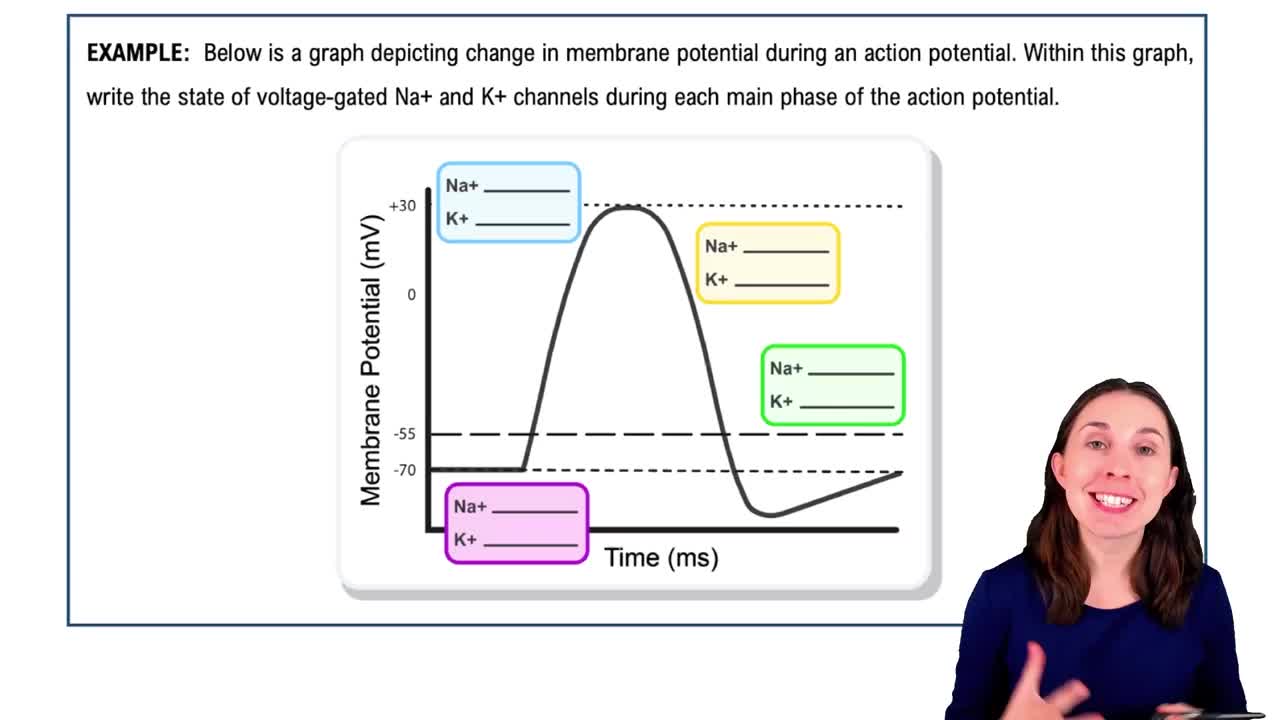
Action Potentials Example 1