Ch. 14 The Autonomic Nervous System and Homeostasis
Amerman - Human Anatomy & Physiology 2nd Edition
Amerman2nd EditionHuman Anatomy & PhysiologyISBN: 9780136873822Not the one you use?Change textbook
Chapter 14, Problem 8

Mark each of the following as an effect of the sympathetic nervous system or the parasympathetic nervous system.
a. ________ Bronchodilation
b.________ Bronchoconstriction
c. ________ Constriction of pupil
d. ________ Vasoconstriction of blood vessels serving organs of digestive, urinary, and integumentary systems
e. ________ Increased metabolic rate
f. ________ Dilation of pupil
g.________ Contraction of smooth muscle of digestive tract

Verified step by step guidance
1
Step 1: Understand the roles of the sympathetic and parasympathetic nervous systems. The sympathetic nervous system is responsible for the 'fight or flight' response, preparing the body for action by increasing heart rate, dilating airways, and redirecting blood flow to essential organs. The parasympathetic nervous system, on the other hand, is responsible for the 'rest and digest' response, promoting relaxation and normal bodily functions like digestion and energy conservation.
Step 2: Analyze each effect listed in the problem and determine whether it aligns with the 'fight or flight' (sympathetic) or 'rest and digest' (parasympathetic) response. For example, bronchodilation (widening of airways) is associated with the sympathetic nervous system because it helps increase oxygen intake during stressful situations.
Step 3: Match each effect to the correct nervous system based on its physiological function. For instance, bronchoconstriction (narrowing of airways) is associated with the parasympathetic nervous system, as it occurs during relaxation when the body does not need increased oxygen intake.
Step 4: Consider the effects on blood vessels and pupils. Vasoconstriction of blood vessels serving digestive, urinary, and integumentary systems is a sympathetic response, as blood is redirected to muscles and essential organs during stress. Similarly, pupil dilation is a sympathetic response to allow more light into the eyes for better vision in emergencies, while pupil constriction is a parasympathetic response during relaxation.
Step 5: Evaluate the effects on metabolic rate and smooth muscle contraction in the digestive tract. Increased metabolic rate is a sympathetic response to provide energy for action, while contraction of smooth muscle in the digestive tract is a parasympathetic response to promote digestion during rest.

Verified video answer for a similar problem:

This video solution was recommended by our tutors as helpful for the problem above.
Was this helpful?

Key Concepts

Here are the essential concepts you must grasp in order to answer the question correctly.

Sympathetic Nervous System

The sympathetic nervous system (SNS) is part of the autonomic nervous system responsible for the body's 'fight or flight' response. It prepares the body for stressful situations by increasing heart rate, dilating airways (bronchodilation), and redirecting blood flow away from non-essential functions like digestion. This system enhances alertness and energy availability, making it crucial for immediate survival.
Recommended video:
1:21
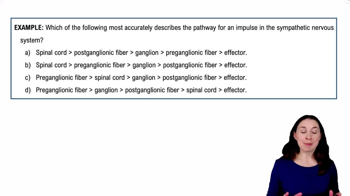
Sympathetic Nervous System Example 3

Parasympathetic Nervous System

The parasympathetic nervous system (PNS) is the counterpart to the SNS, often referred to as the 'rest and digest' system. It promotes relaxation and conservation of energy by slowing the heart rate, stimulating digestion, and facilitating bodily functions that occur during restful states. Key actions include bronchoconstriction and pupil constriction, which help the body to recover and maintain homeostasis.
Recommended video:
1:56
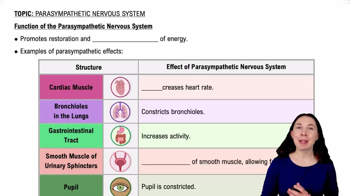
Function of the Parasympathetic Nervous System

Autonomic Nervous System

The autonomic nervous system (ANS) regulates involuntary physiological functions, including heart rate, blood pressure, respiration, and digestion. It is divided into the sympathetic and parasympathetic systems, which work in opposition to maintain balance in the body. Understanding the ANS is essential for analyzing how different stimuli can trigger specific responses, such as those listed in the question.
Recommended video:
1:50
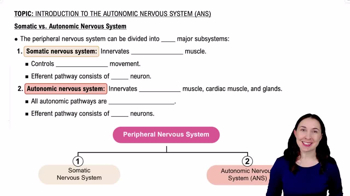
Somatic vs. Autonomic Nervous System