Ch. 13 The Peripheral Nervous System
Amerman - Human Anatomy & Physiology 2nd Edition
Amerman2nd EditionHuman Anatomy & PhysiologyISBN: 9780136873822Not the one you use?Change textbook
Chapter 13, Problem 4

First, write the Roman numeral that corresponds to each named cranial nerve (after the abbreviation CN). Second, match the cranial nerve with its correct function from the column on the right.


CN____               
______Vestibulocochlear nerve
CN____           
______Trigeminal nerve
CN____           
_______Hypoglossal nerve
CN____           
_______Abducens nerve
CN____           
_______Vagus nerve
CN____           
_______Olfactory nerve
CN____            
_______Accessory nerve
CN____           
_______Oculomotor nerve
CN____           
_______Facial nerve
CN____           
_______Optic nerve
CN____           
_______Glossopharyngeal nerve
CN____           
_______Trochlear nerve


a. Motor to the lateral rectus muscle
b. Motor to the muscles of facial expression; lacrimation; salivation; taste to the anterior two-thirds of the tongue
c. Sense of smell
d. Motor to the muscles for swallowing; salivation; taste to the posterior one-third of the tongue; somatic sensation from the throat
e. Senses of hearing and equilibrium
f. Motor to the superior oblique muscle
g. Motor to the tongue
h. Motor to the sternocleidomastoid and trapezius muscles
i. Sense of vision
j. Motor to muscles of swallowing and speaking; parasympathetic innervation to thoracic and abdominal viscera; sense of taste from the throat
k. Sensory to the face; motor to the muscles of mastication
l. Motor to four of six extrinsic eye muscles; constricts the pupil; changes the shape of the lens; opens the eyelid

Verified step by step guidance
1
Step 1: Identify the Roman numeral for each cranial nerve based on its name. The cranial nerves are numbered I through XII in order of their position from the front to the back of the brain. For example, CN I corresponds to the Olfactory nerve, CN II corresponds to the Optic nerve, and so on.
Step 2: Match each cranial nerve with its correct function. For example, the Vestibulocochlear nerve (CN VIII) is responsible for senses of hearing and equilibrium, while the Hypoglossal nerve (CN XII) provides motor function to the tongue.
Step 3: Continue matching each cranial nerve to its function using the descriptions provided. For instance, the Trigeminal nerve (CN V) is responsible for sensory input to the face and motor function for mastication, and the Abducens nerve (CN VI) controls motor function to the lateral rectus muscle.
Step 4: Pay attention to the specific functions of each nerve, such as the Vagus nerve (CN X), which is involved in swallowing, speaking, parasympathetic innervation to thoracic and abdominal viscera, and taste from the throat. Similarly, the Oculomotor nerve (CN III) controls four of six extrinsic eye muscles, pupil constriction, lens shape, and eyelid opening.
Step 5: Once all cranial nerves are matched with their Roman numerals and functions, review the list to ensure accuracy. Double-check that each nerve's function aligns with its anatomical role and the descriptions provided.

Key Concepts

Here are the essential concepts you must grasp in order to answer the question correctly.

Cranial Nerves

Cranial nerves are twelve pairs of nerves that emerge directly from the brain, primarily responsible for sensory and motor functions of the head and neck. Each cranial nerve is designated by a Roman numeral (I-XII) based on its position from front to back. Understanding the specific functions and pathways of these nerves is crucial for identifying their roles in bodily functions and diagnosing neurological conditions.
Recommended video:
Guided course
8:20
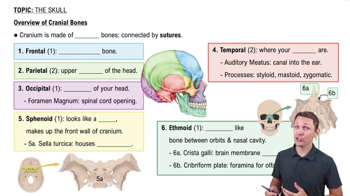
Overview of Cranial Bones

Functions of Cranial Nerves

Each cranial nerve has specific functions, which can be sensory, motor, or both. For example, the olfactory nerve (CN I) is responsible for the sense of smell, while the facial nerve (CN VII) controls muscles of facial expression. Familiarity with these functions is essential for accurately matching each cranial nerve to its corresponding role in the body.
Recommended video:
Guided course
8:20
Overview of Cranial Bones

Nerve Abbreviations and Roman Numerals

Cranial nerves are often referred to by their abbreviations (e.g., CN II for the optic nerve) and are numbered using Roman numerals. This system helps in organizing and identifying the nerves systematically. Understanding this notation is important for students to effectively communicate and reference cranial nerves in both academic and clinical settings.
Recommended video:
Guided course
2:25
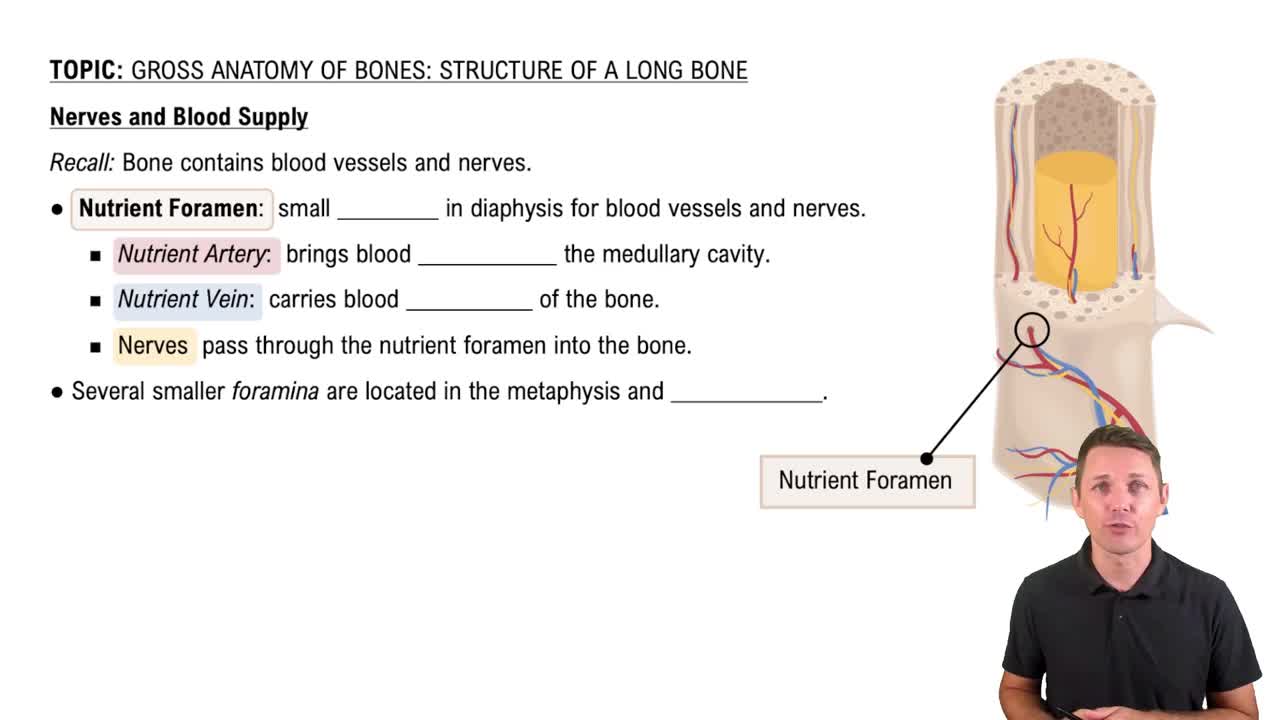
Nerves and Blood Supply
Related Practice
Textbook Question

Define each of the following terms in your own words, using 20 or fewer words.

a. Peripheral nerve

3
views
Textbook Question

First-order somatic sensory neurons are_____neurons whose cell bodies are located in the_____.


a. Multipolar, posterior horn

b. Pseudounipolar, posterior root ganglion

c. Bipolar, anterior horn

d. Pseudounipolar, posterior horn

1
views
Textbook Question

Define each of the following terms in your own words, using 20 or fewer words.

b. Nerve plexus

2
views
Textbook Question

Which cranial nerves are sensory only, primarily motor, and mixed?

1
views
Textbook Question

Match the following nerves with the structures they innervate.     


____Phrenic nerve     

____Median nerve     

____Femoral nerve     

____Tibial nerve     

____Radial nerve     

____Intercostal nerves     

____Common fibular nerve     

____Musculocutaneous nerve


a. Motor to the triceps brachii muscle and muscles in the forearm that extend the hand; sensory from the posterior hand

b. Motor to the muscles in the anterior arm that flex the forearm; sensory from skin over the lateral forearm

c. Motor to the muscles in the anterior and lateral leg that evert and dorsiflex the foot; sensory from the skin of the anteroinferior leg

d. Motor to the diaphragm muscle

e. Motor to the muscles in the anterior thigh extend the knee; sensory from the skin over the anterior thigh and leg

f. Motor to the hamstring muscles that extend the thigh and flex the leg, muscles of the leg that plantarflex the foot, and muscles of the foot; sensory from the skin over the posterior and lateral leg and foot

g. Motor to the muscles between the ribs and the abdominal muscles; sensory from the skin over the abdomen

h. Motor to the muscles in the forearm that flex the hand, certain intrinsic hand muscles; sensory from the skin of the anterior hand

2
views
Textbook Question

Define each of the following terms in your own words, using 20 or fewer words.

c. Posterior root ganglion

11
views