Ch. 11 Introduction to the Nervous System and Nervous Tissue
Amerman - Human Anatomy & Physiology 2nd Edition
Amerman2nd EditionHuman Anatomy & PhysiologyISBN: 9780136873822Not the one you use?Change textbook
Chapter 11, Problem L3.5

Predict the effect that tetrodotoxin would have on Albert's muscle fiber action potentials (see question 3). Would it affect end-plate potentials at the motor end plate? Why or why not?

Verified step by step guidance
1
Understand the role of tetrodotoxin (TTX): Tetrodotoxin is a potent neurotoxin that blocks voltage-gated sodium (Na⁺) channels, preventing the influx of Na⁺ ions during depolarization. This is critical for generating action potentials in excitable cells, such as neurons and muscle fibers.
Analyze the effect of TTX on muscle fiber action potentials: Since muscle fiber action potentials depend on the opening of voltage-gated Na⁺ channels to initiate depolarization, TTX would inhibit the generation of action potentials in muscle fibers by blocking these channels.
Consider the role of end-plate potentials (EPPs): End-plate potentials are localized depolarizations at the motor end plate caused by the binding of acetylcholine (ACh) to nicotinic receptors, which opens ligand-gated ion channels. This process is independent of voltage-gated Na⁺ channels.
Determine if TTX affects EPPs: Since TTX specifically blocks voltage-gated Na⁺ channels and not the ligand-gated ion channels involved in EPP generation, it would not directly affect the formation of end-plate potentials at the motor end plate.
Summarize the overall effect: TTX would prevent the propagation of action potentials in muscle fibers by blocking voltage-gated Na⁺ channels, but it would not interfere with the generation of end-plate potentials, as these are mediated by ligand-gated ion channels at the motor end plate.

Verified video answer for a similar problem:

This video solution was recommended by our tutors as helpful for the problem above.
Was this helpful?

Key Concepts

Here are the essential concepts you must grasp in order to answer the question correctly.

Tetrodotoxin Mechanism

Tetrodotoxin is a potent neurotoxin that blocks voltage-gated sodium channels in nerve and muscle cells. By inhibiting these channels, tetrodotoxin prevents the influx of sodium ions, which is crucial for the generation and propagation of action potentials. This blockage leads to a failure in the transmission of electrical signals, affecting muscle contraction and nerve communication.
Recommended video:
3:02
Internal Regulation - The Myogenic Mechanism

Action Potentials

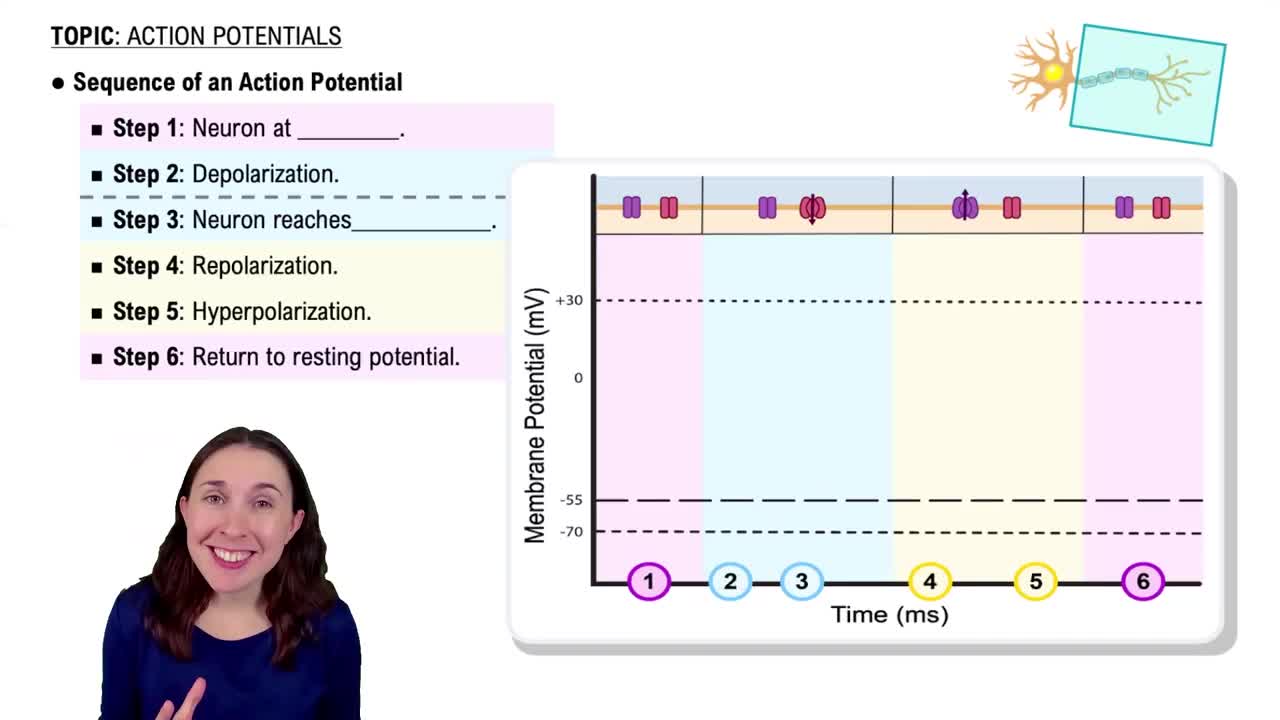
Action potentials are rapid, temporary changes in the membrane potential of a neuron or muscle fiber, allowing for the transmission of signals. They are initiated when a threshold level of depolarization is reached, primarily through the opening of sodium channels. In muscle fibers, action potentials trigger the release of calcium ions, leading to muscle contraction, making their integrity essential for normal muscle function.
Recommended video:
03:53
Action Potential

End-Plate Potentials

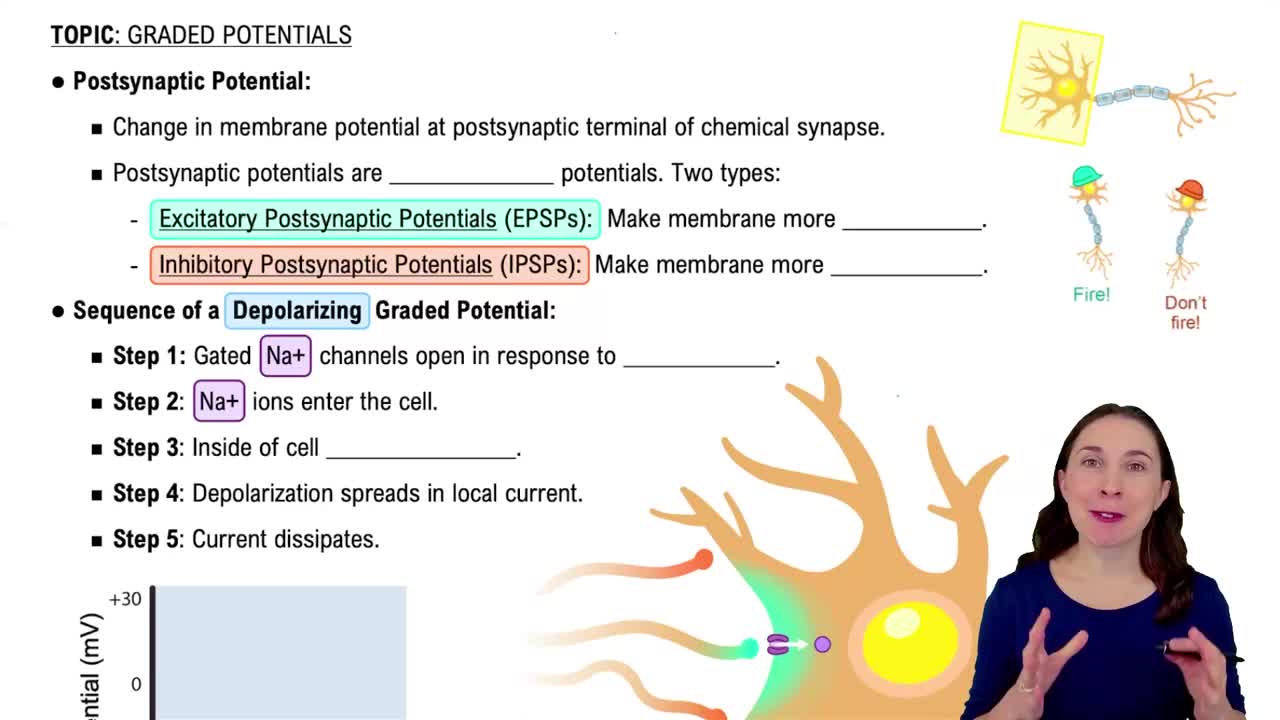
End-plate potentials (EPPs) are localized depolarizations that occur at the motor end plate, where motor neurons communicate with muscle fibers. EPPs are generated by the binding of neurotransmitters, such as acetylcholine, to receptors on the muscle membrane, leading to the opening of ion channels. While tetrodotoxin primarily affects action potentials in the muscle fiber, it does not directly block EPPs, as these are initiated by neurotransmitter release rather than action potentials.
Recommended video:
05:55
Postsynaptic Potential