Ch. 10 Muscle Tissue and Physiology
Amerman - Human Anatomy & Physiology 2nd Edition
Amerman2nd EditionHuman Anatomy & PhysiologyISBN: 9780136873822Not the one you use?Change textbook
Chapter 10, Problem 11

Which of the following energy sources would provide the majority of the ATP for a person running a 26-mile marathon?
a. Stored ATP
b. Glycolytic catabolism
c. Oxidative catabolism
d. Creatine phosphate

Verified step by step guidance
1
Understand the context of the problem: A marathon is a long-duration, endurance activity that requires sustained energy production over several hours. This means the body must rely on energy systems capable of producing ATP efficiently over a prolonged period.
Review the energy systems: The body has several ways to produce ATP: (a) Stored ATP, which is limited and only lasts a few seconds, (b) Glycolytic catabolism, which provides ATP quickly but is limited to short bursts of activity and produces lactic acid, (c) Oxidative catabolism, which is slower but highly efficient and sustainable for long durations, and (d) Creatine phosphate, which provides a rapid but very short-term supply of ATP.
Eliminate options that are not suitable for a marathon: Stored ATP and creatine phosphate are used for very short-term, high-intensity activities (lasting seconds). Glycolytic catabolism is more suited for moderate-duration, high-intensity activities (lasting a few minutes) and is not efficient for long-duration events like a marathon.
Focus on oxidative catabolism: This system uses oxygen to break down carbohydrates, fats, and sometimes proteins to produce ATP. It is the primary energy source for endurance activities because it can sustain ATP production for hours.
Conclude that oxidative catabolism is the most appropriate energy source for a marathon runner, as it provides the majority of ATP required for prolonged, steady-state exercise.

Verified video answer for a similar problem:

This video solution was recommended by our tutors as helpful for the problem above.
Was this helpful?

Key Concepts

Here are the essential concepts you must grasp in order to answer the question correctly.

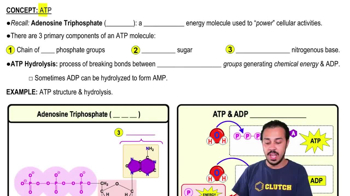
ATP Production

Adenosine triphosphate (ATP) is the primary energy currency of the cell, providing the energy needed for various biological processes. During prolonged physical activities, such as running a marathon, the body relies on different metabolic pathways to produce ATP, with varying efficiency and duration.
Recommended video:

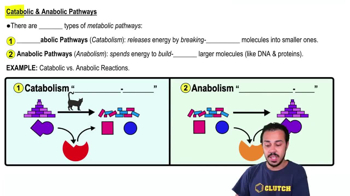
Glycolytic Catabolism

Glycolytic catabolism refers to the breakdown of glucose to produce ATP, primarily through anaerobic processes. This pathway is crucial during high-intensity activities but is limited in duration, typically providing energy for activities lasting up to a few minutes before transitioning to more sustainable energy sources.
Recommended video:
03:25
Catabolic & Anabolic Pathways

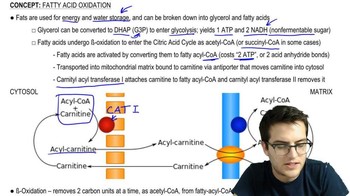
Oxidative Catabolism

Oxidative catabolism is the process of producing ATP through the aerobic breakdown of carbohydrates, fats, and proteins. This pathway is highly efficient and can sustain energy production for extended periods, making it the primary source of ATP during endurance activities like marathon running.
Recommended video:
11:34
Fatty Acid Oxidation 1
Related Practice
Textbook Question

Mark the following statements as true or false. If a statement is false, correct it to make a true statement.

Muscle fibers generate more tension if the starting length of their sarcomeres is very short.

2
views
Textbook Question

Which of the following statements accurately describes the role of ATP in a muscle contraction?

a. ATP is directly responsible for the power stroke.

b. ATP moves troponin and tropomyosin away from actin.

c. ATP breaks the actin/myosin attachment and 'cocks' the myosin head.

d. ATP causes the myofilaments to shorten.

1
views
Textbook Question

Mark the following statements as true or false. If a statement is false, correct it to make a true statement.

Muscles that require a great deal of precise control will have large motor units.

2
views
Textbook Question

Order the following events of excitation and excitation-contraction coupling. Put 1 by the first event, 2 by the second, and so on.

____ The motor end plate generates an end-plate potential.

____ The action potential spreads along the T-tubules, SR Ca2+ channels are pulled open, and Ca2+ floods the cytosol.

____ Acetylcholine binds to receptors on the motor end plate, and ligand-gated ion channels open.

____ Ca2+ bind troponin, which allows tropomyosin to move away from the actin active site, initiating a contraction cycle.

____ The action potential propagates through the sarcolemma and dives deeply into the cell along the T-tubules.

1
views
Textbook Question

A muscle fiber relaxes when:

a. The concentration of Ca2+ in the cytosol returns to resting levels.

b. The supply of ATP is exhausted.

c. Ca2+ flood the cytosol.

d. Acetylcholine is released from the axon terminal and the sarcolemma depolarizes.

1
views
Textbook Question

Mark the following statements as true or false. If a statement is false, correct it to make a true statement.

Stimulation by a motor neuron before a muscle fiber has fully relaxed results in a condition called wave summation.

2
views