Ch. 10 Muscle Tissue and Physiology
Amerman - Human Anatomy & Physiology 2nd Edition
Amerman2nd EditionHuman Anatomy & PhysiologyISBN: 9780136873822Not the one you use?Change textbook
Chapter 10, Problem L2.2

The primary action of the biceps brachii muscle of the anterior arm is to flex the forearm at the elbow. However, when this muscle is inflamed, pain is felt in the shoulder. Explain this finding.

Verified step by step guidance
1
Understand the anatomy of the biceps brachii muscle: The biceps brachii is a two-headed muscle located in the anterior compartment of the arm. It originates from two points in the shoulder region—the short head from the coracoid process of the scapula and the long head from the supraglenoid tubercle of the scapula.
Recognize the dual function of the biceps brachii: While its primary action is flexion of the forearm at the elbow, the biceps brachii also plays a role in stabilizing the shoulder joint due to its attachment points in the shoulder region.
Understand the concept of referred pain: Pain felt in one area of the body can originate from another area due to shared nerve pathways or interconnected structures. In this case, inflammation of the biceps brachii can irritate structures in the shoulder region, leading to pain perception in the shoulder.
Consider the role of inflammation: When the biceps brachii muscle becomes inflamed, the irritation can affect surrounding tissues, including the tendons and ligaments in the shoulder joint. This can lead to discomfort or pain in the shoulder area.
Relate the anatomical connection to the symptom: Since the long head of the biceps brachii passes through the shoulder joint and attaches to the supraglenoid tubercle, inflammation in the muscle or its tendon can directly impact the shoulder, causing pain in that region.

Verified video answer for a similar problem:

This video solution was recommended by our tutors as helpful for the problem above.
Was this helpful?

Key Concepts

Here are the essential concepts you must grasp in order to answer the question correctly.

Biceps Brachii Function

The biceps brachii is a major muscle in the anterior arm responsible for flexing the forearm at the elbow and assisting in shoulder movements. It has two heads that originate from the shoulder and insert into the radius bone of the forearm, allowing it to play a crucial role in both elbow flexion and supination of the forearm.
Recommended video:
06:04
Functional Groups

Referred Pain

Referred pain occurs when discomfort is perceived in a location different from the source of the pain. In the case of biceps brachii inflammation, the pain may be felt in the shoulder due to the shared nerve pathways and the anatomical proximity of the shoulder and elbow, leading to confusion in the brain about the actual source of the pain.
Recommended video:
1:36
The Cerebrum Example 3

Inflammation and Pain Response

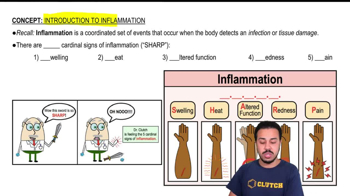
Inflammation is the body's response to injury or irritation, characterized by swelling, redness, and pain. When the biceps brachii is inflamed, it can lead to increased sensitivity and pain not only at the site of inflammation but also in surrounding areas, such as the shoulder, due to the interconnected nature of muscle and nerve tissues.
Recommended video:
1:38
Inflammation
Related Practice
Textbook Question

Mark the following statements as true or false. If a statement is false, correct it to make a true statement.

The plasma membrane of a muscle cell is called the sarcoplasmic reticulum.

Textbook Question

Mark the following statements as true or false. If a statement is false, correct it to make a true statement.

Muscle cells are contractile, conductive, distensible cells.

2
views
Textbook Question

How does a skeletal muscle fiber differ structurally from typical cells?

2
views
Textbook Question

Some athletes will consume only protein for several days before a competition, which reduces the amount of glycogen in both the muscle fibers and the liver. What effect would this have on their ability to perform activities that require short, powerful bursts of activity? How would it affect their ability to perform endurance activities?

1
views
Textbook Question

Jesse is a 2-year-old boy who presents with difficulty in walking and poor control of movements. When the doctor examines Jesse, she notices that when his muscles contract, they are very slow to relax and remain contracted well after the movement has been performed. She sends a sample of his tissue for genetic analysis, and the lab reports a genetic defect that causes the pumps in the SR to operate much more slowly than normal. How does a defect in DNA lead to a malfunctioning protein? How does this finding explain Jesse's symptoms?

1
views
Textbook Question

Ms. Sanchez was in a motorcycle accident in which she lost the use of her right upper limb muscles due to significant nerve damage. However, when an electrode is inserted into her muscles, they are able to contract. Explain specifically why nerve damage caused her to lose the use of her muscles. Why can they still respond to stimulation from an electrode?

1
views