Ch. 10 Muscle Tissue and Physiology
Amerman - Human Anatomy & Physiology 2nd Edition
Amerman2nd EditionHuman Anatomy & PhysiologyISBN: 9780136873822Not the one you use?Change textbook
Chapter 10, Problem 4

Match the following terms with the correct definition.      


____Z-disc     
____Sarcomere     
____A band     
____H zone     
____I band     
____M line


a. The dark band containing the entire length of the thick filament
b. The band of proteins in the middle of the H zone
c. The boundary between sarcomeres
d. The functional unit of contraction
e. The middle region of the A band containing only thick filaments
f. The light band containing only thin filaments

Verified step by step guidance
1
Step 1: Understand the terms and their roles in muscle anatomy. These terms are related to the structure of a sarcomere, which is the functional unit of a muscle fiber. A sarcomere is composed of repeating units of thick and thin filaments, and the arrangement of these filaments creates distinct bands and zones.
Step 2: Match the term 'Z-disc' with its definition. The Z-disc (or Z-line) is the boundary between sarcomeres, where thin filaments are anchored. This corresponds to definition (c).
Step 3: Match the term 'Sarcomere' with its definition. The sarcomere is the functional unit of contraction in a muscle fiber, as it is the smallest unit capable of contracting. This corresponds to definition (d).
Step 4: Match the term 'A band' with its definition. The A band is the dark band that contains the entire length of the thick filament, including regions where thick and thin filaments overlap. This corresponds to definition (a).
Step 5: Continue matching the remaining terms: 'H zone' is the middle region of the A band containing only thick filaments (e), 'I band' is the light band containing only thin filaments (f), and 'M line' is the band of proteins in the middle of the H zone (b).

Verified video answer for a similar problem:

This video solution was recommended by our tutors as helpful for the problem above.
Was this helpful?

Key Concepts

Here are the essential concepts you must grasp in order to answer the question correctly.

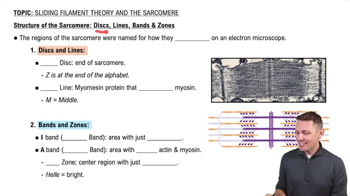
Z-disc

The Z-disc, or Z-line, is a structural component of a sarcomere, which serves as the boundary between adjacent sarcomeres in a muscle fiber. It anchors the thin filaments (actin) and plays a crucial role in the contraction process by maintaining the alignment of the sarcomere during muscle contraction and relaxation.
Recommended video:
Guided course
6:01
Structure of the Sarcomere: Bands, Zones, Discs & Lines

Sarcomere

The sarcomere is the fundamental unit of muscle contraction, defined as the segment between two Z-discs. It contains overlapping thick (myosin) and thin (actin) filaments, and its contraction is responsible for the shortening of muscle fibers, enabling movement. Understanding the structure of the sarcomere is essential for grasping how muscles function.
Recommended video:
Guided course
7:18
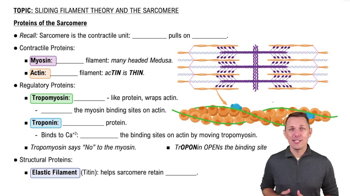
Proteins of the Sarcomere

A band

The A band is the dark region of the sarcomere that contains the entire length of the thick filaments (myosin) and overlaps with the thin filaments (actin). This band is crucial for muscle contraction, as it represents the area where the force is generated during the sliding filament mechanism. The A band remains constant in length during contraction, while the I band and H zone change.
Recommended video:
Guided course
6:01
Structure of the Sarcomere: Bands, Zones, Discs & Lines
Related Practice
Textbook Question

Which of the following statements accurately describes the role of ATP in a muscle contraction?

a. ATP is directly responsible for the power stroke.

b. ATP moves troponin and tropomyosin away from actin.

c. ATP breaks the actin/myosin attachment and 'cocks' the myosin head.

d. ATP causes the myofilaments to shorten.

1
views
Textbook Question

Paola is a 3-year-old girl with a disease that reduces the ability of her mitochondria to generate ATP. Explain the specific effects of this disease on the ability of Paola's muscles to function properly. What other tissues and organs are likely to be especially affected by her disease, and why?

1
views
Textbook Question

Mr. Nasheed has cerebral palsy and suffers severe skeletal muscle spasms as a result of his condition. He is prescribed the drug dantrolene, which prevents the release of Ca2+ from the SR. Explain how this will treat his muscle spasms.

2
views
Textbook Question

Order the following events of excitation and excitation-contraction coupling. Put 1 by the first event, 2 by the second, and so on.

____ The motor end plate generates an end-plate potential.

____ The action potential spreads along the T-tubules, SR Ca2+ channels are pulled open, and Ca2+ floods the cytosol.

____ Acetylcholine binds to receptors on the motor end plate, and ligand-gated ion channels open.

____ Ca2+ bind troponin, which allows tropomyosin to move away from the actin active site, initiating a contraction cycle.

____ The action potential propagates through the sarcolemma and dives deeply into the cell along the T-tubules.

1
views
Textbook Question

Some athletes will consume only protein for several days before a competition, which reduces the amount of glycogen in both the muscle fibers and the liver. What effect would this have on their ability to perform activities that require short, powerful bursts of activity? How would it affect their ability to perform endurance activities?

1
views
Textbook Question

What is the basic mechanism of contraction at the level of myofilaments?

2
views