Back

Steps of Transcription quiz

Control buttons has been changed to "navigation" mode.
1/15
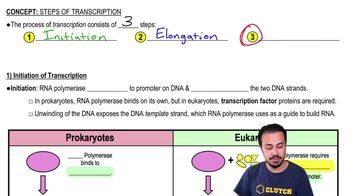
  • What are the three main steps of transcription?

    The three main steps are initiation, elongation, and termination.
  • During initiation, what does RNA polymerase bind to on the DNA?

    RNA polymerase binds to the promoter region on the DNA.
  • How does the initiation of transcription differ between prokaryotes and eukaryotes?

    In prokaryotes, RNA polymerase binds directly to the promoter, while in eukaryotes, transcription factors are required for RNA polymerase to bind.
  • What is the role of transcription factors in eukaryotic transcription initiation?

    Transcription factors help recruit RNA polymerase to the promoter region in eukaryotes.
  • What happens to the DNA strands during the initiation of transcription?

    The two DNA strands are separated, exposing the template strand for RNA synthesis.
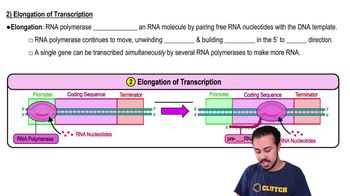
  • What is the main function of RNA polymerase during elongation?

    RNA polymerase synthesizes the RNA molecule by pairing free RNA nucleotides with the DNA template strand.
  • In which direction does RNA polymerase synthesize the new RNA strand?

    RNA polymerase synthesizes RNA in the 5' to 3' direction.
  • What is the result of the elongation step in transcription?

    A growing RNA molecule is produced, carrying the genetic message from the DNA.
  • Can multiple RNA polymerases transcribe the same gene at the same time?

    Yes, several RNA polymerases can transcribe a single gene simultaneously to produce more RNA.
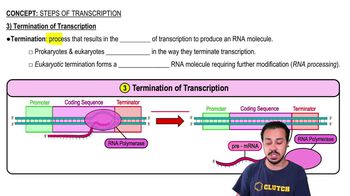
  • What signals the end of transcription during the termination step?

    A terminator sequence on the DNA signals the end of transcription.
  • What happens to the RNA polymerase and RNA molecule during termination?

    Both the RNA polymerase and the newly synthesized RNA molecule are released from the DNA.
  • How does the RNA produced in prokaryotes differ from that in eukaryotes after termination?

    In prokaryotes, the RNA is ready for translation immediately, while in eukaryotes, it is a premature RNA that requires further processing.
  • What is the premature RNA called in eukaryotes after transcription?

    It is called pre-mRNA.
  • Why does pre-mRNA in eukaryotes require further processing?

    Pre-mRNA must undergo RNA processing to become mature mRNA before it can be translated.
  • Is RNA processing required for prokaryotic RNA after transcription?

    No, prokaryotic RNA does not require processing and is ready for translation immediately.