Skip to main content
Anatomy & Physiology
My Course
Learn
Exam Prep
AI Tutor
Study Guides
Textbook Solutions
Flashcards
Explore
Try the app
My Course
Learn
Exam Prep
AI Tutor
Study Guides
Textbook Solutions
Flashcards
Explore
Try the app
Back
Review of Aerobic Cellular Respiration quiz
You can tap to flip the card.
What are the four stages of aerobic cellular respiration?
You can tap to flip the card.
👆
What are the four stages of aerobic cellular respiration?
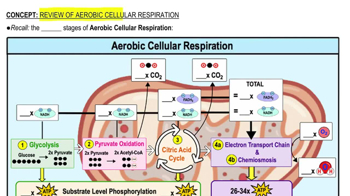
The four stages are glycolysis, pyruvate oxidation, the Krebs cycle (citric acid cycle), and oxidative phosphorylation.
Track progress
Control buttons has been changed to "navigation" mode.
1/15
Related flashcards
Recommended videos
Review of Aerobic Cellular Respiration definitions
Review of Aerobic Cellular Respiration
15 Terms
07:25
Total Products for Each Stage of Aerobic Cellular Respiration
7
views
07:51
Review of Aerobic Cellular Respiration
9
views
Terms in this set (15)
Hide definitions
What are the four stages of aerobic cellular respiration?
The four stages are glycolysis, pyruvate oxidation, the Krebs cycle (citric acid cycle), and oxidative phosphorylation.
Where does glycolysis occur within the cell?
Glycolysis occurs in the cytoplasm, just outside the mitochondria.
What is the starting molecule for glycolysis and what are its main products?
The starting molecule is glucose, and the main products are 2 pyruvate, 2 ATP (net), and 2 NADH.
How many carbon dioxide molecules are produced during glycolysis?
Zero carbon dioxide molecules are produced during glycolysis.
What happens to the pyruvate molecules produced in glycolysis?
The 2 pyruvate molecules are transported into the mitochondrial matrix for pyruvate oxidation.
What are the products of pyruvate oxidation?
Pyruvate oxidation produces 2 NADH, 2 acetyl CoA, and releases 2 CO2.
How many ATP molecules are produced during pyruvate oxidation?
Zero ATP molecules are produced during pyruvate oxidation.
What is the starting do molecule for the Krebs cycle and what are its main products?
The starting molecule is 2 acetyl CoA, and the main products are 2 ATP, 6 NADH, 2 FADH2, and 4 CO2.
How many total carbon dioxide molecules are released from one glucose molecule during aerobic respiration?
A total of 6 carbon dioxide molecules are released, corresponding to the 6 carbons in glucose.
What is the main purpose of the electron carriers NADH and FADH2 in cellular respiration?
NADH and FADH2 carry electrons to the electron transport chain for ATP production during oxidative phosphorylation.
Where does oxidative phosphorylation occur and what are its main products?
Oxidative phosphorylation occurs in the mitochondria and produces 26-34 ATP and water.
What acts as the final electron acceptor in the electron transport chain?
Oxygen gas (O2) acts as the final electron acceptor, forming water.
How many total ATP molecules are produced from one glucose molecule in aerobic respiration?
A total of 30-38 ATP molecules are produced from one glucose molecule.
What is the ending molecule of the Krebs cycle and why is it significant?
The ending molecule is oxaloacetate, which is regenerated to continue the cycle.
How many NADH and FADH2 molecules are produced in total from one glucose during aerobic respiration?
A total of 10 NADH and 2 FADH2 molecules are produced from one glucose.
 BackBack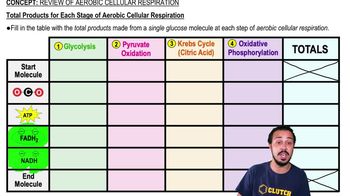
 07:25
07:25