Skip to main content
Anatomy & Physiology
My Course
Learn
Exam Prep
AI Tutor
Study Guides
Textbook Solutions
Flashcards
Explore
Try the app
My Course
Learn
Exam Prep
AI Tutor
Study Guides
Textbook Solutions
Flashcards
Explore
Try the app
Back
Introduction to Tissues & Histology quiz #1
You can tap to flip the card.
What is the relationship between cells and tissues?
You can tap to flip the card.
👆
What is the relationship between cells and tissues?
Tissues are groups of similar cells that work together to perform related functions, including their extracellular matrix.
Track progress
Control buttons has been changed to "navigation" mode.
1/39
Related flashcards
Related practice
Recommended videos
Introduction to Tissues & Histology definitions
Introduction to Tissues & Histology
15 Terms
Introduction to Tissues & Histology quiz #2
Introduction to Tissues & Histology
26 Terms
Introduction to Tissues & Histology quiz #3
Introduction to Tissues & Histology
10 Terms
Introduction to Tissues & Histology
4. Tissues & Histology
4 problems
Topic
Bruce
Introduction to Epithelial Tissue
4. Tissues & Histology
3 problems
Topic
4. Tissues & Histology - Part 1 of 2
9 topics
14 problems
Chapter
Bruce
4. Tissues & Histology - Part 2 of 2
12 topics
16 problems
Chapter
Bruce
03:32
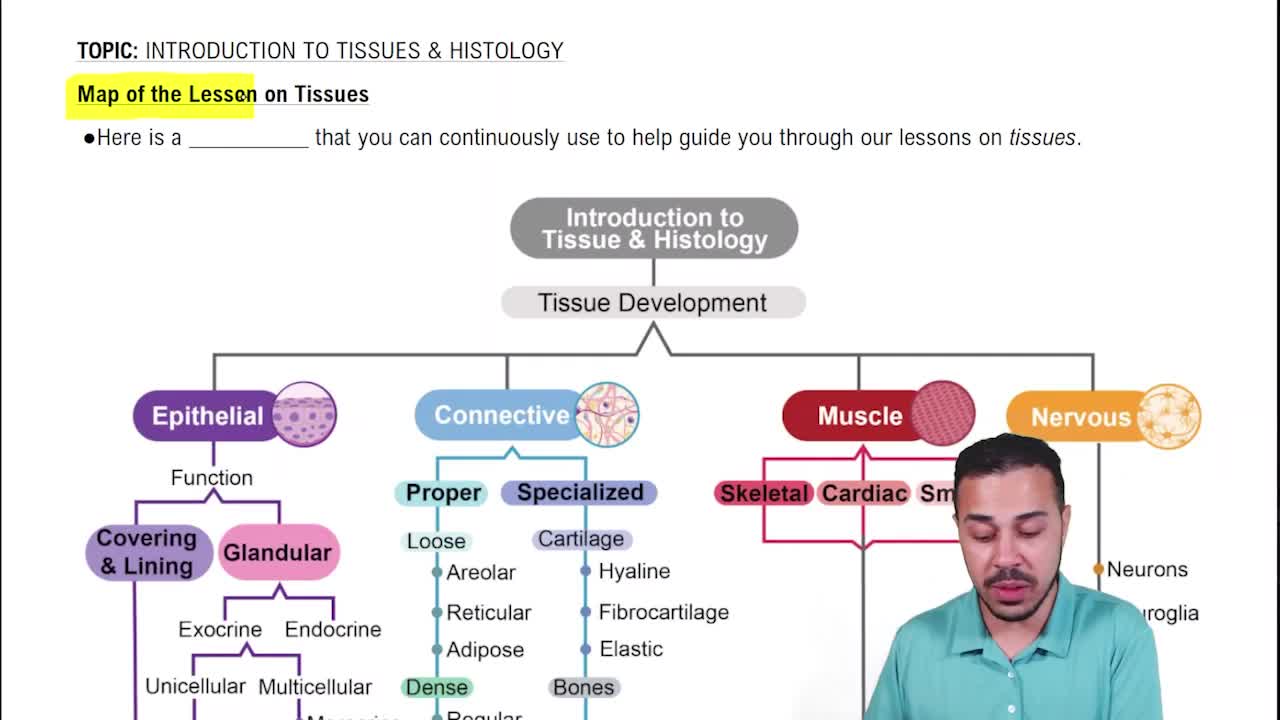
Map of the Lesson on Tissues
10
views
02:52
What is Histology?
11
views
04:14
Intro to Human Tissues
19
views
2
rank
Terms in this set (39)
Hide definitions
What is the relationship between cells and tissues?
Tissues are groups of similar cells that work together to perform related functions, including their extracellular matrix.
Which of these make up the vascular tissue? Sclerenchyma, Collenchyma, Parenchyma, Phloem
Phloem is part of the vascular tissue.
What are the three main types of body membranes?
The three main types of body membranes are mucous membranes, serous membranes, and cutaneous membranes.
What tissue has lacunae?
Cartilage tissue has lacunae, which are small spaces that house cells.
Which cell type is not a primary meristematic cell found in apical meristems?
Sclerenchyma is not a type of primary meristematic cell found in apical meristems.
Which tissue is not found in the stem?
Myeloid is not a tissue found in the stem.
What are the parts included in the stem tissue?
Epidermis, Cortex, Pith, Xylem, Phloem are parts included in the stem tissue.
Why are adipose tissues important?
Adipose tissues are important for storing energy in the form of triglycerides, providing insulation, and cushioning organs.
Which body tissue consists largely of material outside of the cell?
Connective tissue consists largely of material outside of the cell, known as the extracellular matrix.
What is the unit of structure for a tissue?
The unit of structure for a tissue is the cell.
What type of tissue covers the epiphysis of bones and reduces friction in the joints?
Cartilage tissue covers the epiphysis of bones and reduces friction in the joints.
Which type of tissue forms a communication and coordination system within the body?
Nervous tissue forms a communication and coordination system within the body.
Which is not a type of tissue?
Bone is not a type of tissue; it is a specialized connective tissue.
Which tissue type or organ is correctly matched with its germ layer tissue? Epithelial - Ectoderm, Muscle - Mesoderm, Nervous - Endoderm
Muscle - Mesoderm is correctly matched with its germ layer tissue.
Which of these make up the vascular tissue? Sclerenchyma, Collenchyma, Parenchyma, Phloem
Phloem is part of the vascular tissue.
What are the three major types of tissue membranes?
The three major types of tissue membranes are mucous membranes, serous membranes, and cutaneous membranes.
Which is not a step in tissue repair?
Calcification is not a step in tissue repair.
What tissue serves as the model for bones formed during endochondral ossification?
Cartilage tissue serves as the model for bones formed during endochondral ossification.
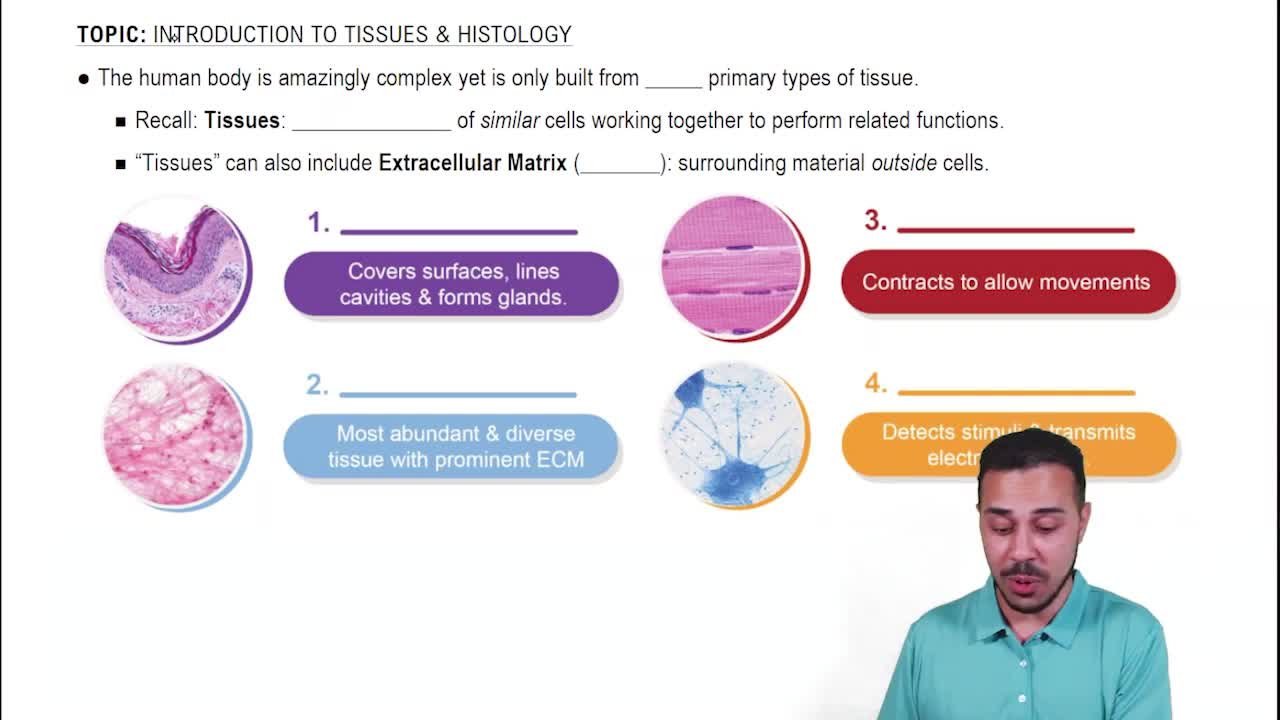
What are the four primary types of tissue?
The four primary types of tissue are epithelial, connective, muscle, and nervous tissues.
Which of these is not one of the four major categories of tissue? Epithelial, Connective, Muscle, Bone
Bone is not one of the four major categories of tissue; it is a specialized connective tissue.
Which type of tissue stores triglycerides?
Adipose tissue stores triglycerides.
Which of these tissues has lacunae?
Cartilage tissue has lacunae.
Which describes vessel elements and tracheids at maturity?
Vessel elements and tracheids are dead at maturity and function in water transport.
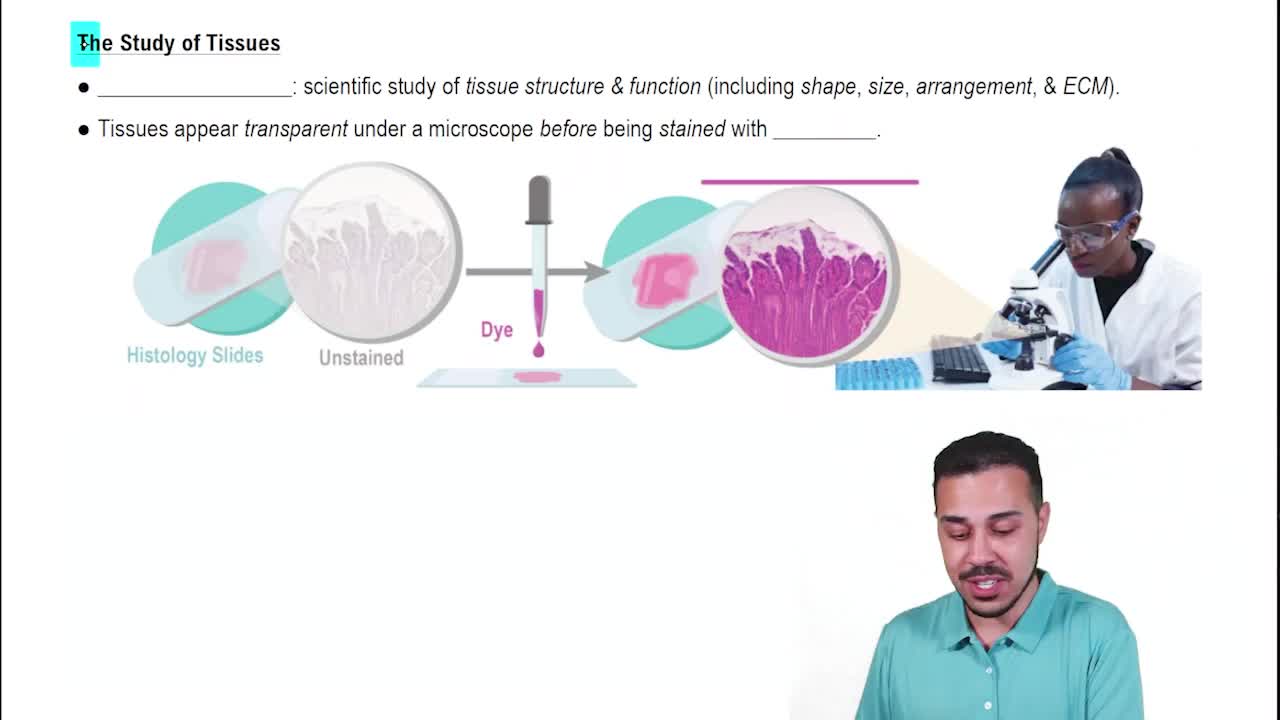
What is the study of the structure and function of tissues called?
Histology is the study of the structure and function of tissues.
How are histones related to nucleosomes?
Histones are proteins around which DNA is wrapped to form nucleosomes, the basic unit of chromatin structure.
Which is not one of the four basic types of body tissues?
Bone is not one of the four basic types of body tissues; it is a specialized connective tissue.
What are tissues made of?
Tissues are made of groups of similar cells and their extracellular matrix.
What type of tissue is not tightly woven?
Connective tissue is not tightly woven, as it has a prominent extracellular matrix.
Which histone helps stabilize the solenoid structure?
Histone H1 helps stabilize the solenoid structure of chromatin.
In which type of tissue are cells separated by a matrix?
In connective tissue, cells are separated by a matrix.
Distinguish between a tiny root and a root hair. What is the function of a root hair?
A tiny root is a part of the root system, while a root hair is an extension of a root cell that increases surface area for absorption.
What is the most diverse tissue type in the body?
Connective tissue is the most diverse tissue type in the body.
Which type of tissue is designed to stretch?
Elastic connective tissue is designed to stretch.
What tissue is classified as myeloid?
Bone marrow tissue is myeloid.
Which type of tissue fills internal spaces of the body?
Connective tissue fills internal spaces of the body.
How does monocot root structure differ from dicot root structure?
Monocot roots have a fibrous root system, while dicot roots typically have a taproot system.
Which type of tissue provides structure and support for the body?
Connective tissue provides structure and support for the body.
Which tissue type includes two major inter-dependent types of cells?
Nervous tissue includes neurons and neuroglia, two major inter-dependent types of cells.
Which layers give rise to all of the body's mature tissues?
The three germ layers, ectoderm, mesoderm, and endoderm, give rise to all of the body's mature tissues.
 BackBack
 03:32
03:32