Back

Introduction to the Central Nervous System quiz #1

Control buttons has been changed to "navigation" mode.
1/40
  • Which region of the brain is the largest?

    Forebrain
  • What structure connects the right and left cerebral hemispheres?

    The corpus callosum connects the right and left cerebral hemispheres.
  • The limbic system is responsible for which functions?

    The limbic system is responsible for emotions, memory, and arousal.
  • What functions is the limbic system involved in?

    Emotion, memory, and arousal.
  • Name a structure of the midbrain.

    The midbrain includes structures such as the superior and inferior colliculi.
  • What is the function of Broca's area in the brain?

    Broca's area is responsible for speech production.
  • What are some functions of the midbrain?

    The midbrain is involved in vision, hearing, motor control, sleep/wake, arousal, and temperature regulation.
  • What part of the limbic system of the brain is most involved in emotions?

    The amygdala is most involved in emotions.
  • Where are the hippocampus and amygdala found?

    The hippocampus and amygdala are found in the limbic system.
  • What is the function of the Wernicke area?

    Wernicke's area is responsible for language comprehension.
  • Which nerve tracts do not decussate?

    Some nerve tracts in the spinal cord do not decussate, meaning they do not cross over to the opposite side.
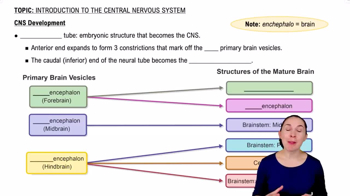
  • From which embryonic brain region does the medulla oblongata develop?

    c. rhombencephalon
  • What is the function of the association areas located in the occipital lobe?

    The association areas in the occipital lobe are involved in visual processing.
  • Which brain structure is part of the limbic system?

    b. amygdala
  • What is the function of Wernicke's area in the brain?

    Wernicke's area is responsible for the comprehension of speech.
  • What is the function of Broca’s area?

    Broca’s area is involved in speech production.
  • Which brain structure plays a central role in the experience of fear?

    The amygdala plays a central role in the experience of fear.
  • What is not a function of cerebrospinal fluid?

    c. transmitting nerve impulses
  • Which of these parts of the brain is correctly matched with its region? a. cerebrum - hindbrain b. thalamus - forebrain c. medulla - midbrain

    b. thalamus - forebrain
  • What is a late sign of increased intracranial pressure?

    A late sign of increased intracranial pressure is a change in pupil size or reactivity.
  • Split-brain research demonstrates what important aspect of brain function?

    Split-brain research demonstrates the lateralization of brain function, showing that the two hemispheres have specialized functions.
  • Which of these does the limbic system control? a. voluntary movement b. emotional responses c. digestion

    b. emotional responses
  • Which of these statements is not correct regarding our limbic system?

    The limbic system is not primarily responsible for voluntary motor control.
  • Which region of the brain is responsible for coordination of movement?

    The cerebellum is responsible for coordination of movement.
  • Where in the brain is the association cortex and what functions does it support?

    The association cortex is found in various lobes of the brain and supports complex functions such as perception, thought, and decision-making.
  • What is a function of the association areas of the frontal lobes?

    The association areas of the frontal lobes are involved in planning, decision-making, and personality.
  • Which brain structure is located in the hindbrain?

    a. cerebellum
  • Which division of the nervous system is responsible for voluntary control of skeletal muscle?

    The somatic nervous system is responsible for voluntary control of skeletal muscle.
  • With what is Broca's area associated?

    Broca's area is associated with speech production.
  • Which part of the brain controls balance and coordination?

    The cerebellum controls balance and coordination.
  • Which part of the limbic system is responsible for learning and memory?

    The hippocampus is responsible for learning and memory.
  • What should the nurse assess to test the function of the temporal lobe?

    The nurse should assess language comprehension and auditory processing to test the function of the temporal lobe.
  • Which part of the limbic system plays a key role in the emotions of fear and aggression?

    The amygdala plays a key role in the emotions of fear and aggression.
  • Which structure is part of the midbrain?

    b. superior colliculi
  • What is the primary function of the occipital lobes in the brain?

    The occipital lobes are primarily responsible for visual processing.
  • What is the primary function of the occipital lobe?

    The occipital lobe is primarily involved in visual processing.
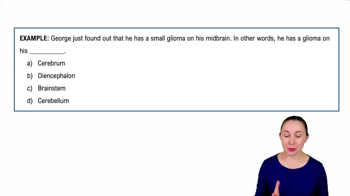
  • How many regions make up the brain stem?

    The brain stem is made up of three regions: the midbrain, pons, and medulla oblongata.
  • What functional centers are associated with the medulla oblongata?

    The medulla oblongata contains centers for regulating heart rate, breathing, and blood pressure.
  • What role does the reticular formation play in the nervous system?

    The reticular formation is involved in regulating sleep-wake cycles and consciousness.
  • Which component of the limbic system plays an essential role in the formation of new memories?

    The hippocampus plays an essential role in the formation of new memories.