Back

Introduction to Sensory Receptors quiz #1

Control buttons has been changed to "navigation" mode.
1/39
  • The auditory cortex is located in which lobe of the brain?

    The auditory cortex is located in the temporal lobe of the brain.
  • Which structure is part of the vestibular system?

    Semicircular canals
  • Damage to which structure best explains conduction deafness?

    Tympanic membrane
  • Where are sound vibrations converted into nerve impulses?

    Sound vibrations are converted into nerve impulses in the cochlea.
  • Where are equilibrium receptors located?

    Equilibrium receptors are located in the vestibular apparatus of the inner ear.
  • Where do sound vibrations get transformed into neural signals that can be sent to the brain?

    Sound vibrations are transformed into neural signals in the cochlea.
  • Which sense is not first routed through the thalamus?

    Smell
  • What is the function of sensory (afferent) neurons?

    Transmit signals from sensory receptors to the central nervous system
  • Where in the body would you find sense receptors?

    Sense receptors are found throughout the body, including the skin, eyes, ears, nose, and tongue.
  • To what stimulus are the baroreceptors in the carotid sinus and aortic arch sensitive?

    Blood pressure changes
  • Where are receptors for dynamic equilibrium located and what do they detect?

    Receptors for dynamic equilibrium are located in the semicircular canals and detect rotational movements of the head.
  • Which sense uses thermoreceptors?

    Touch
  • Which type of psychoactive drug is best known for altering sense perceptions? Options: Stimulants, Depressants, Hallucinogens, Opiates

    Hallucinogens
  • Which organ contains the sensory receptors for light?

    The eye contains the sensory receptors for light.
  • Which brain structure relays incoming sensory information?

    The thalamus relays incoming sensory information.
  • Where are the sensory neurons found in a spinal nerve?

    Sensory neurons are found in the dorsal root of a spinal nerve.
  • Which way can the nurse decrease the sensory deprivation that the client in isolation experiences?

    The nurse can decrease sensory deprivation by providing visual and auditory stimuli, such as music or conversation.
  • How many odors can humans distinguish between?

    Humans can distinguish between thousands of different odors.
  • Which events occur during bright light adaptation?

    During bright light adaptation, the pupils constrict, and photoreceptor sensitivity decreases to prevent overstimulation.
  • Where are the sensory receptors for sound? Options: Tongue, Nose, Ears, Eyes

    Ears
  • Which sensation might mechanoreceptors detect?

    Pressure
  • What is false about mechanoreceptors?

    Mechanoreceptors do not respond to chemical stimuli; they respond to mechanical pressure or distortion.
  • What senses use chemoreceptors to react to stimuli?

    The senses of taste and smell use chemoreceptors to react to stimuli.
  • Where are end bulbs located?

    End bulbs are located in the skin and mucous membranes, where they detect touch and pressure.
  • Where are the sensory receptors for sound?

    The sensory receptors for sound are located in the cochlea of the inner ear.
  • What is detected by the hair cells in the semicircular canals?

    The hair cells in the semicircular canals detect rotational movements of the head.
  • Which sensory receptors respond to temperature changes?

    Thermoreceptors respond to temperature changes.
  • Which is the correct description for sensory receptors?

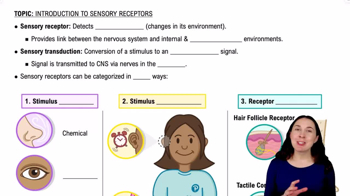
    Sensory receptors are specialized cells that detect specific types of stimuli and convert them into electrical signals.
  • How are the sensory receptors for smell and taste similar?

    Both smell and taste receptors are chemoreceptors that detect chemicals dissolved in fluids.
  • What is the function of sensory receptors?

    The function of sensory receptors is to detect stimuli and convert them into electrical signals for the nervous system.
  • What cell receives stimuli and transmits impulses to neurons or to receptors in other organs?

    Sensory receptor cells receive stimuli and transmit impulses to neurons or other receptors.
  • What are the sensory organs for the sense of dynamic equilibrium?

    The semicircular canals in the inner ear are the sensory organs for dynamic equilibrium.
  • What structure acts as a relay station for all senses except smell?

    The thalamus acts as a relay station for all senses except smell.
  • Where does the signal go after leaving the hair cells?

    After leaving the hair cells, the signal travels to the brain via the auditory nerve.
  • What information does the brain use to determine the intensity of a stimulus?

    The brain uses the frequency of action potentials and the number of activated receptors to determine stimulus intensity.
  • Where are free nerve endings most abundant?

    Free nerve endings are most abundant in the skin.
  • Low frequency sounds stimulate hair cells on which part of the basilar membrane?

    Low frequency sounds stimulate hair cells at the apex of the basilar membrane.
  • What is the primary function of a sensory receptor?

    The primary function of a sensory receptor is to detect specific stimuli and convert them into electrical signals.
  • What is an advantage of binocular vision?

    An advantage of binocular vision is improved depth perception.