Anatomy & Physiology
My Course
Learn
Exam Prep
AI Tutor
Study Guides
Textbook Solutions
Flashcards
Explore
Try the app
My Course
Learn
Exam Prep
AI Tutor
Study Guides
Textbook Solutions
Flashcards
Explore
Try the app
Back
Introduction to Cells of the Immune System definitions
You can tap to flip the card.
Sentinel cells
You can tap to flip the card.
👆
Sentinel cells
Guard cells in the immune system that detect invading microbes using censoring systems.
Track progress
Control buttons has been changed to "navigation" mode.
1/15
Related flashcards
Recommended videos
Introduction to Cells of the Immune System quiz
Introduction to Cells of the Immune System
20 Terms
6:08
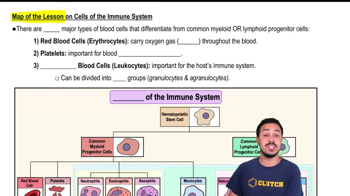
Map of the Lesson on Cells of the Immune System
1
views
3:27
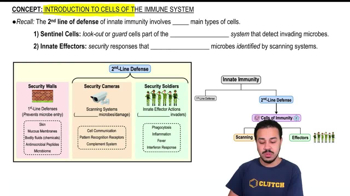
Second-Line Defenses
1
views
2:33
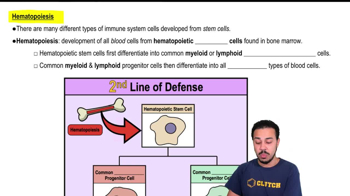
Hematopoeisis
1
views
Terms in this set (15)
Hide definitions
Sentinel cells
Guard cells in the immune system that detect invading microbes using censoring systems.
Innate effectors
Cells that eliminate identified microbes, acting as security soldiers in the immune response.
Hematopoiesis
The process of developing blood cells from hematopoietic stem cells in the bone marrow.
Hematopoietic stem cells
Cells in the bone marrow that differentiate into common myeloid and lymphoid progenitor cells.
Common myeloid progenitor
A cell type derived from hematopoietic stem cells that differentiates into various blood cells.
Common lymphoid progenitor
A cell type derived from hematopoietic stem cells that differentiates into lymphocytes.
Erythrocytes
Red blood cells responsible for carrying oxygen throughout the body.
Platelets
Cell fragments important for blood clotting, derived from myeloid progenitor cells.
Leukocytes
White blood cells crucial for the immune system, divided into granulocytes and agranulocytes.
Granulocytes
A group of leukocytes including neutrophils, eosinophils, and basophils.
Agranulocytes
A group of leukocytes including lymphocytes such as T cells, B cells, and natural killer cells.
Natural killer cells
Lymphocytes part of innate immunity, responsible for destroying infected or cancerous cells.
T cells
Lymphocytes part of adaptive immunity, involved in cell-mediated immune responses.
B cells
Lymphocytes part of adaptive immunity, responsible for producing antibodies.
Pattern recognition receptors
Molecules on sentinel cells that detect microbial components and initiate immune responses.