Skip to main content
Anatomy & Physiology
My Course
Learn
Exam Prep
AI Tutor
Study Guides
Textbook Solutions
Flashcards
Explore
Try the app
My Course
Learn
Exam Prep
AI Tutor
Study Guides
Textbook Solutions
Flashcards
Explore
Try the app
Back
Introduction to Blood Vessels quiz #1
You can tap to flip the card.
Which artery branches into the common hepatic artery?
You can tap to flip the card.
👆
Which artery branches into the common hepatic artery?
The celiac trunk branches into the common hepatic artery.
Track progress
Control buttons has been changed to "navigation" mode.
1/39
Related flashcards
Related practice
Recommended videos
Introduction to Blood Vessels definitions
Introduction to Blood Vessels
15 Terms
Introduction to Blood Vessels quiz #2
Introduction to Blood Vessels
20 Terms
Introduction to Blood Vessels quiz #3
Introduction to Blood Vessels
14 Terms
Introduction to Blood Vessels
19. The Blood Vessels
4 problems
Topic
Jason
Types of Blood Vessels
19. The Blood Vessels
4 problems
Topic
Jason
19. The Blood Vessels - Part 1 of 2
4 topics
10 problems
Chapter
Jason
19. The Blood Vessels - Part 2 of 2
4 topics
9 problems
Chapter
Bruce
Guided course
3:38
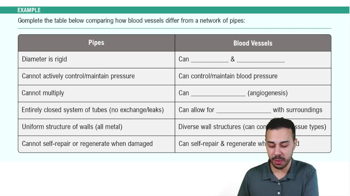
Introduction to Blood Vessels Example 1
4
views
Guided course
4:59
Blood Vessels
4
views
Guided course
2:04
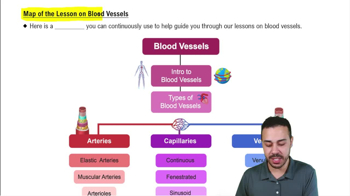
Map of the Lesson on Blood Vessels
6
views
Terms in this set (39)
Hide definitions
Which artery branches into the common hepatic artery?
The celiac trunk branches into the common hepatic artery.
What complication is the nurse aware of that is associated with deep venous thrombosis?
Pulmonary embolism is a complication associated with deep venous thrombosis.
Which vessels allow for oxygen movement into the tissues?
Capillaries allow for oxygen movement into the tissues.
Which blood vessel carries blood into a glomerulus?
The afferent arteriole carries blood into a glomerulus.
Which vessels serve as the blood reservoirs of the body?
Veins serve as the blood reservoirs of the body.
What mechanism does not assist venous return?
High blood pressure
What is not true regarding fenestrated capillaries?
They are impermeable to large molecules
Which type of blood vessels have venous valves?
Veins
Which blood vessels carry blood away from the heart?
Arteries carry blood away from the heart.
Why might the body need to increase vessel length?
To accommodate growth
Which artery supplies blood to the thigh?
The femoral artery supplies blood to the thigh.
What connects arteries and veins in the human circulatory system?
Capillaries
What is vascular tissue?
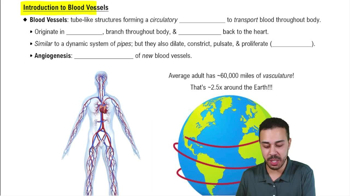
Vascular tissue is composed of blood vessels that transport blood throughout the body.
Where in the body are blood vessels found?
Blood vessels are found throughout the entire body, except in avascular areas like cartilage.
What is not a function of the blood vessels of the dermis?
Hormone production
How does blood vessel length change with body growth?
It increases with body growth
The external jugular vein drains directly into what vessel?
The external jugular vein drains into the subclavian vein.
What is the correct order of vessels as blood flows through the liver?
Hepatic artery/portal vein → liver sinusoids → central vein → hepatic vein
Which statement accurately describes blood vessels?
Blood vessels form a circulatory network that transports blood throughout the body.
How can the blood vessels alter the temperature of the body?
Blood vessels can dilate or constrict to release or conserve heat, respectively.
Which vessels carry blood away from the heart?
Arteries carry blood away from the heart.
What are the characteristics of arterial bleeding?
It is bright red and spurts
Which type of blood vessels have valves?
Veins
Which vessels deliver oxygen-poor blood to the lungs?
The pulmonary arteries deliver oxygen-poor blood to the lungs.
How do veins return blood to the heart? Select all that apply. A) Skeletal muscle pump B) Respiratory pump C) Gravity D) Venous valves
A) Skeletal muscle pump, B) Respiratory pump, D) Venous valves
Which blood vessel delivers oxygenated blood to the liver?
The hepatic artery delivers oxygenated blood to the liver.
Which veins drain into the inferior vena cava?
The renal vein, hepatic vein, and common iliac vein drain into the inferior vena cava.
Which is the correct order of vessels through which blood flows through the liver?
Hepatic artery/portal vein → liver sinusoids → central vein → hepatic vein
What does not contribute to venous return?
High blood pressure
Do these vessels carry oxygenated blood or deoxygenated blood? A) Pulmonary veins B) Pulmonary arteries
A) Pulmonary veins carry oxygenated blood, B) Pulmonary arteries carry deoxygenated blood
What cells make up the visceral capillaries of the glomerulus?
Endothelial cells make up the visceral capillaries of the glomerulus.
Which circuit contains the aorta and vena cava?
The systemic circuit contains the aorta and vena cava.
Which small blood vessels distribute blood throughout the body?
Capillaries distribute blood throughout the body.
Which vessels typically carry blood away from the heart?
Arteries typically carry blood away from the heart.
What is a correct statement about human blood vessels?
Capillaries connect arteries and veins, allowing for exchange of substances.
What blood vessels hold the greatest volume of blood?
Veins hold the greatest volume of blood.
Which blood vessels have valves?
Veins have valves to prevent backflow of blood.
What factor does not aid in venous return?
High blood pressure
Which blood vessel of the pulmonary circuit will carry deoxygenated blood?
The pulmonary arteries carry deoxygenated blood in the pulmonary circuit.
 BackBack

 3:38
3:38