What are the two types of phosphorylation that produce ATP during aerobic cellular respiration?
The two types are substrate level phosphorylation and oxidative phosphorylation.
During which stages of aerobic cellular respiration does substrate level phosphorylation occur?
Substrate level phosphorylation occurs during glycolysis and the Krebs cycle.
How does substrate level phosphorylation generate ATP?
It directly transfers a phosphate group from a substrate to ADP using an enzyme.
How many ATP molecules are produced by substrate level phosphorylation in glycolysis and the Krebs cycle each?
Each process produces 2 ATP molecules via substrate level phosphorylation.
What is the main difference between substrate level phosphorylation and oxidative phosphorylation?
Substrate level phosphorylation directly transfers a phosphate group to ADP, while oxidative phosphorylation uses energy from redox reactions to generate ATP.
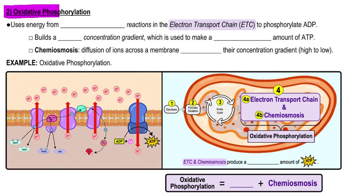
What are the two steps involved in oxidative phosphorylation?
The two steps are the electron transport chain (ETC) and chemiosmosis.
What is the role of the electron transport chain in oxidative phosphorylation?
The electron transport chain builds a hydrogen ion (H+) concentration gradient using energy from redox reactions.
What is chemiosmosis and how does it contribute to ATP production?
Chemiosmosis is the diffusion of hydrogen ions across a membrane down their concentration gradient, which is used to phosphorylate ADP and produce ATP.
Which stage of aerobic cellular respiration is responsible for producing the majority of ATP?
The majority of ATP is produced during the fourth and final stage, oxidative phosphorylation.
Does substrate level phosphorylation occur during pyruvate oxidation or the electron transport chain?
No, substrate level phosphorylation does not occur during pyruvate oxidation or the electron transport chain.
What is the main energy source used in oxidative phosphorylation to generate ATP?
Oxidative phosphorylation uses energy from oxidation-reduction (redox) reactions.
What is the total ATP yield from substrate level phosphorylation compared to oxidative phosphorylation?
Substrate level phosphorylation produces a small amount (4 ATP total), while oxidative phosphorylation produces the vast majority of ATP.
What is the function of the enzyme in substrate level phosphorylation?
The enzyme catalyzes the transfer of a phosphate group from the substrate to ADP, forming ATP.
Why is oxidative phosphorylation considered the final stage of aerobic cellular respiration?
Because it occurs after glycolysis, pyruvate oxidation, and the Krebs cycle, and is responsible for most ATP production.
What is the biggest takeaway about oxidative phosphorylation from the lesson?
Oxidative phosphorylation generates a large amount of ATP and is essential for the cell's energy supply during aerobic respiration.
 Back
Back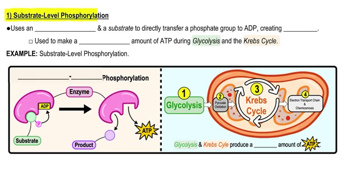
 02:59
02:59