Ch. 18 The Cardiovascular System: The Heart
Marieb - Human Anatomy & Physiology 11th Edition
Marieb, Hoehn11th EditionHuman Anatomy & PhysiologyISBN: 9780136874034Not the one you use?Change textbook
Chapter 18, Problem 25

Hannah, a newborn baby, needs surgery because she was born with an aorta that arises from the right ventricle and a pulmonary trunk that issues from the left ventricle, a condition called transposition of the great vessels. What are the physiological consequences of this defect?

Verified step by step guidance
1
Step 1: Understand the normal anatomy and physiology of the heart's great vessels. Normally, the aorta arises from the left ventricle and carries oxygenated blood to the systemic circulation, while the pulmonary trunk arises from the right ventricle and carries deoxygenated blood to the lungs for oxygenation.
Step 2: Identify the abnormality in transposition of the great vessels. In this condition, the aorta arises from the right ventricle and the pulmonary trunk arises from the left ventricle, effectively reversing the normal blood flow pathways.
Step 3: Analyze the physiological consequence of this reversal. Because the aorta is connected to the right ventricle, it receives deoxygenated blood and sends it to the systemic circulation, while the pulmonary trunk connected to the left ventricle sends oxygenated blood back to the lungs instead of the body.
Step 4: Recognize that this creates two parallel circulations instead of the normal series circulation: one loop circulates deoxygenated blood through the body without oxygenation, and the other circulates oxygenated blood between the lungs and the left heart without delivering it to the body.
Step 5: Conclude that without any mixing of blood between these two circuits (such as through a septal defect or patent ductus arteriosus), the body tissues will be deprived of oxygen, leading to severe hypoxia and cyanosis, which is life-threatening and requires surgical correction.

Key Concepts

Here are the essential concepts you must grasp in order to answer the question correctly.

Transposition of the Great Vessels

This congenital heart defect involves the aorta arising from the right ventricle and the pulmonary artery from the left ventricle, reversing the normal blood flow. It causes two separate circulations: oxygen-poor blood circulates through the body, and oxygen-rich blood circulates through the lungs, leading to severe hypoxia.
Recommended video:
4:59
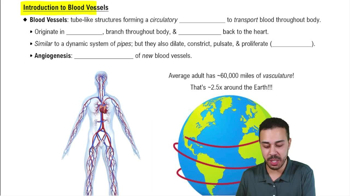
Blood Vessels

Circulatory Physiology and Oxygenation

Normal circulation involves oxygen-poor blood traveling to the lungs for oxygenation and oxygen-rich blood being pumped to the body. In transposition, this process is disrupted, causing systemic circulation to receive deoxygenated blood, which results in inadequate oxygen delivery to tissues and organs.
Recommended video:
Guided course
02:52
What is Anatomy & Physiology? Example 1

Physiological Consequences and Clinical Implications

The defect leads to cyanosis, low oxygen levels in the body, and potential organ damage if untreated. Survival depends on the presence of shunts like a patent ductus arteriosus or septal defects that allow mixing of oxygenated and deoxygenated blood, highlighting the urgency of surgical correction.
Recommended video:
Guided course
02:52
What is Anatomy & Physiology? Example 1