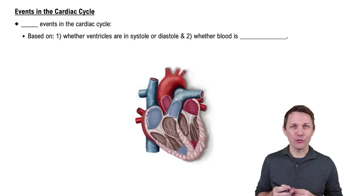
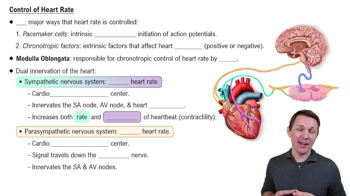
An increase in preload causes a/an ________ in stroke volume in accordance with the ________ law. An increase in afterload causes a/an ________ in stroke volume. An increase in contractility causes a/an ________ in stroke volume.
Cardiac output is equal to:
a. End-diastolic volume minus end-systolic volume.
b. Heart rate multiplied by stroke volume.
c. Stroke volume divided by end-diastolic volume.
d. Heart rate multiplied by preload.
Verified step by step guidance
Verified video answer for a similar problem:
Key Concepts
Cardiac Output
Heart Rate
Stroke Volume
Mark the following statements as true or false. If a statement is false, correct it to make a true statement.
Tissue perfusion to the heart decreases during systole and increases during diastole.
Which of the following statements is false?
a. The sympathetic nervous system releases epinephrine and norepinephrine, which are positive chronotropic and inotropic agents.
b. The endocrine system regulates cardiac output through chronotropic and inotropic hormones and through hormones that regulate water balance.
c. The parasympathetic nervous system releases acetylcholine and epinephrine, which are strongly negative inotropic agents.
d. Factors such as electrolyte concentrations, body temperature, and age all affect cardiac output.

A birth defect called transposition of great vessels results in the pulmonary trunk emanating from the left ventricle and the aorta stemming from the right ventricle.
Which ventricle is thicker-walled, and why?
The first heart sound is called ________ and it is caused by the closing of the ________ valves. It occurs at the beginning of the ________ phase of the cardiac cycle. The second heart sound is called ________ and it is caused by the closing of the ________ valves. It occurs at the beginning of the ________ phase of the cardiac cycle.
Which chamber generates the highest pressure during systole?
a. Right atrium
b. Right ventricle
c. Left atrium
d. Left ventricle