Ch. 8 Articulations
Amerman - Human Anatomy & Physiology 2nd Edition
Amerman2nd EditionHuman Anatomy & PhysiologyISBN: 9780136873822Not the one you use?Change textbook
Chapter 8, Problem 8

Which of the following correctly describes the function of a ligament?
a. It connects a muscle to its attachment point, such as a bone.
b. It is a fluid-filled structure that minimizes friction during movement.
c. It connects two bones to each other in a joint.
d. It surrounds a tendon and protects it in high-stress areas.

Verified step by step guidance
1
Understand the definition of a ligament: A ligament is a tough, fibrous connective tissue that connects bones to other bones at a joint, providing stability and support during movement.
Review the function of tendons: Tendons connect muscles to bones, allowing for movement when muscles contract. This is distinct from ligaments.
Consider the role of bursae: Bursae are fluid-filled sacs that reduce friction between moving structures, such as tendons and bones, but they are not ligaments.
Examine the protective structures around tendons: Tendon sheaths are specialized structures that surround tendons in high-stress areas to protect them, but they are not ligaments.
Identify the correct description: Based on the definitions above, the correct function of a ligament is to connect two bones to each other in a joint, ensuring stability and proper alignment during movement.

Verified video answer for a similar problem:

This video solution was recommended by our tutors as helpful for the problem above.
Was this helpful?

Key Concepts

Here are the essential concepts you must grasp in order to answer the question correctly.

Ligament Function

Ligaments are fibrous connective tissues that connect bones to other bones at joints. Their primary function is to provide stability and support to the joint, preventing excessive movement that could lead to injury. Unlike tendons, which connect muscles to bones, ligaments play a crucial role in maintaining the integrity of the skeletal system during movement.
Recommended video:
06:04
Functional Groups

Joint Anatomy

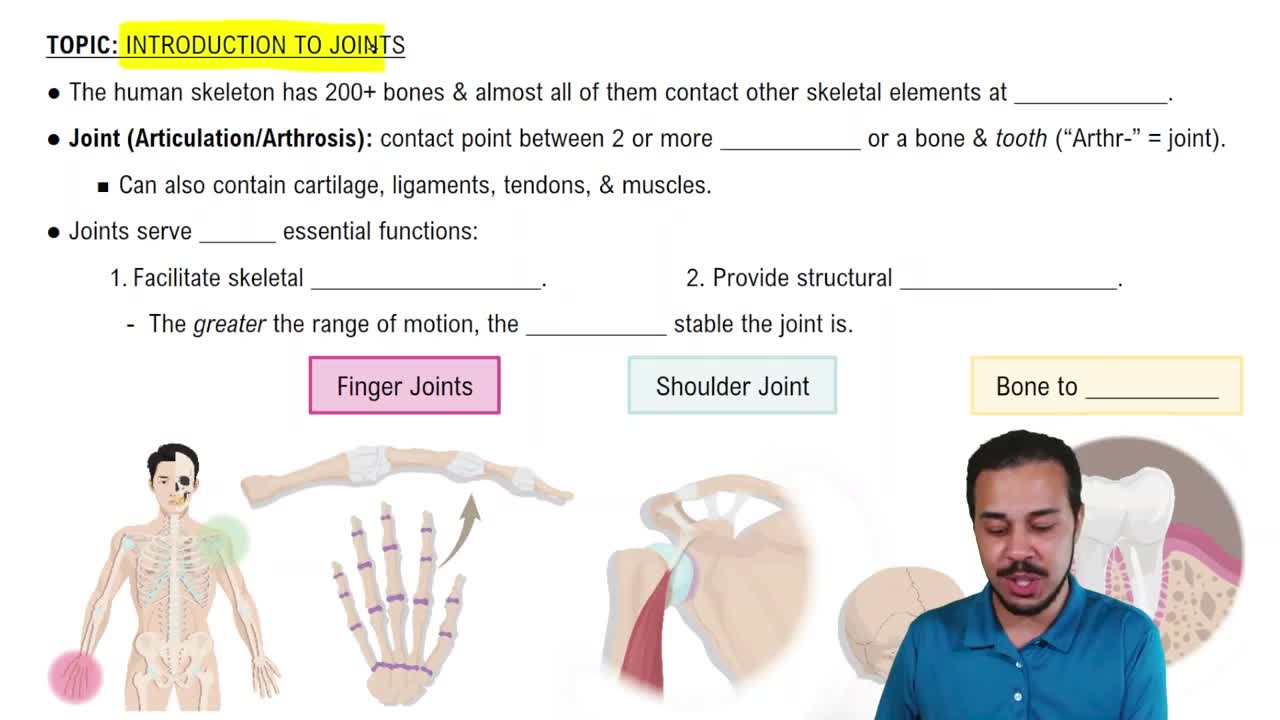
Understanding joint anatomy is essential for recognizing the role of ligaments. Joints are the points where two or more bones meet, and they can be classified into various types, such as hinge, ball-and-socket, and pivot joints. Ligaments are integral to these structures, as they help to stabilize the joint and allow for controlled movement.
Recommended video:
05:39
Introduction to Joints

Common Misconceptions

There are common misconceptions regarding the functions of ligaments, such as confusing them with tendons or synovial fluid structures. While tendons connect muscles to bones and synovial fluid reduces friction in joints, ligaments specifically connect bones to each other, highlighting the importance of distinguishing these connective tissues in anatomy.
Recommended video:
Guided course
04:09
Introduction to Feedback Loops
Related Practice
Textbook Question

Mark the following statements as true or false. If a statement is false, correct it to make a true statement.

Cartilaginous joints are synarthroses.

2
views

Textbook Question

The articulating ends of bones of synovial joints are covered in______. The remaining internal surfaces of the joint are lined by the_____, which produces synovial fluid. The entire joint is encased by the_____, which is composed of dense, irregular collagenous connective tissue.

1
views
Textbook Question

Mark the following statements as true or false. If a statement is false, correct it to make a true statement.

The knee and the elbow are multiaxial joints.

Textbook Question

Match the following terms with the correct definition from the right column. 

Plane joint      

Saddle joint     

Ball-and-socket joint     

Condylar joint     

Pivot joint     

Hinge joint

a. Uniaxial joint in which the rounded articular surface of one bone fits into a groove of another bone and is held in place by a ligamentous ring

b. Multiaxial joint in which the spherical articular surface of one bone fits into a cup or socket of another bone

c. Nonaxial joint in which two flat surfaces glide over each other

d. Uniaxial joint in which the convex articular surface of one bone fits into a concave articular depression

e. Biaxial joint in which the oval, convex articulating surface of one bone fits into the shallow depression of another bone

f. Biaxial joint in which each articular surface has both convex and concave regions

Textbook Question

What is/are the function(s) of synovial fluid?

2
views
Textbook Question

Mark the following statements as true or false. If a statement is false, correct it to make a true statement.

The elbow joint consists of two separate articulations.

1
views