
Ch. 3 The Cell
Amerman - Human Anatomy & Physiology 2nd Edition
Amerman2nd EditionHuman Anatomy & PhysiologyISBN: 9780136873822Not the one you use?Change textbook
Chapter 3, Problem L3.1g

Write a single sentence, using no more than 25 words, to summarize each of the following cellular processes:
DNA synthesis

Verified step by step guidance
1
Understand that DNA synthesis is the process of creating a new DNA strand during cell replication, ensuring genetic information is accurately copied.
Recognize that DNA synthesis occurs during the S phase of the cell cycle, involving enzymes like DNA polymerase and helicase.
Learn that helicase unwinds the DNA double helix, creating a replication fork for the synthesis of new complementary strands.
Explore how DNA polymerase adds nucleotides to the growing strand, following base-pairing rules (A-T and G-C) to ensure accurate replication.
Summarize the process in a concise sentence: 'DNA synthesis is the enzymatic replication of DNA, ensuring genetic fidelity during cell division.'

Verified video answer for a similar problem:

This video solution was recommended by our tutors as helpful for the problem above.
Was this helpful?

Key Concepts

Here are the essential concepts you must grasp in order to answer the question correctly.

DNA Synthesis

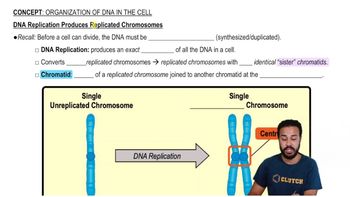
DNA synthesis is the biological process of creating a new DNA strand from nucleotides, essential for cell replication and repair.
Recommended video:
05:13
DNA Replication

Nucleotides

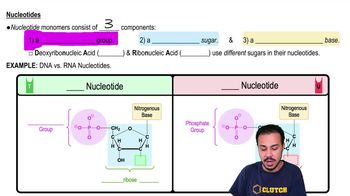
Nucleotides are the building blocks of DNA, consisting of a sugar, phosphate group, and nitrogenous base, which pair to form the DNA double helix.
Recommended video:
05:35
Nucleotides

Enzymes in DNA Synthesis

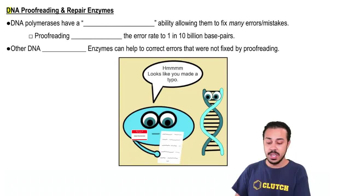
Enzymes like DNA polymerase play a crucial role in DNA synthesis by catalyzing the addition of nucleotides to the growing DNA strand.
Recommended video:
02:12
DNA Proofreading & Repair Enzymes
Related Practice
Textbook Question

A patient is admitted to the hospital and given intravenous (IV) fluids. Four hours later, the patient complains that his mouth and eyes feel dry. You notice that he displays signs of dehydration, and when you check his IV, you see that he was given the wrong kind of fluids. Were these fluids likely hypotonic, isotonic, or hypertonic? Explain.

1
views
Textbook Question

A hypothetical poison prevents transcription factors from binding to the gene for tubulin proteins. What impact would this have on mitosis, and why?

1
views
Textbook Question

Match the following terms with the correct functions.

_____Peroxisome    

_____Ribosome    

_____Smooth endoplasmic reticulum    

_____Mitochondrion    

_____Golgi apparatus    

_____Lysosome    

_____Rough endoplasmic reticulum     

_____Vesicle


a. Modifies and folds proteins into the correct structure

b. Modifies, packages, and sorts proteins

c. Contains digestive enzymes

d. Granular organelle that makes proteins

e. Synthesizes most of a cell's ATP

f. Contains enzymes that oxidize toxins and fatty acids

g. Membrane-enclosed structure used to transport substances through the cell

h. Detoxifies certain chemicals, makes lipids, stores calcium ions

1
views
Textbook Question

Which of the following best describes the arrangement of the main component of the plasma membrane?

a. A monolayer of phospholipids with the phosphate heads facing the cytosol and the fatty acid tails facing the extracellular fluid

b. A bilayer of phospholipids with the phosphate heads facing the cytosol and extracellular fluid, and the fatty acid tails facing one another

c. A bilayer of phospholipids with the phosphate heads of one layer facing the fatty acid tails of the other

d. A bilayer of phospholipids with a layer of triglycerides sandwiched in the middle

1
views
Textbook Question

Write a single sentence, using no more than 25 words, to summarize each of the following cellular processes:

Primary active transport

1
views
Textbook Question

Write a single sentence, using no more than 25 words, to summarize each of the following cellular processes:

Mitosis