Binding of antigens to receptors of immunocompetent lymphocytes leads to clonal selection. Describe the process of clonal selection. What nonlymphocyte cell is a central actor in this process, and what is its function?
Ch. 12 The Lymphatic System and Body Defenses

Marieb13th EditionEssentials of Human Anatomy & PhysiologyISBN: 9780135624340Not the one you use?Change textbook
Chapter 12, Problem 15
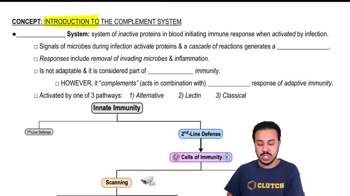
What is complement? Besides bacterial lysis, what are some of the roles of complement?
Verified step by step guidance1
Step 1: Define complement. Complement is a group of proteins found in the blood plasma and on cell surfaces that play a crucial role in the immune system. These proteins work together to enhance the ability of antibodies and phagocytic cells to clear pathogens and damaged cells, promote inflammation, and attack the pathogen's cell membrane.
Step 2: Explain bacterial lysis. Complement proteins can form a membrane attack complex (MAC), which creates pores in the bacterial cell membrane, leading to cell lysis and death of the pathogen.
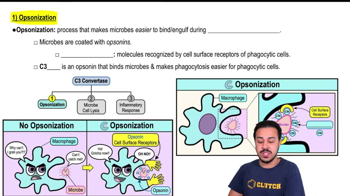
Step 3: Discuss the role of complement in opsonization. Complement proteins, such as C3b, bind to the surface of pathogens, marking them for phagocytosis by immune cells like macrophages and neutrophils.
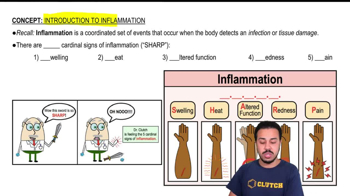
Step 4: Explain the role of complement in inflammation. Complement proteins, such as C3a and C5a, act as chemotactic factors that recruit immune cells to the site of infection and promote inflammation by increasing vascular permeability.
Step 5: Highlight the role of complement in immune clearance. Complement helps remove immune complexes (antigen-antibody complexes) from circulation by facilitating their transport to the liver and spleen for disposal, preventing tissue damage.

Verified video answer for a similar problem:
This video solution was recommended by our tutors as helpful for the problem above.
Video duration:
3mWas this helpful?
Key Concepts
Here are the essential concepts you must grasp in order to answer the question correctly.
Complement System
The complement system is a part of the immune system consisting of proteins that enhance the ability of antibodies and phagocytic cells to clear pathogens from an organism. It plays a crucial role in innate immunity and can be activated through three pathways: classical, lectin, and alternative. This system helps in opsonization, inflammation, and the formation of the membrane attack complex, which can lyse pathogens.
Recommended video:
Complement System
Opsonization
Opsonization is the process by which pathogens are marked for destruction by immune cells. Complement proteins bind to the surface of pathogens, enhancing their recognition and uptake by phagocytes such as macrophages and neutrophils. This process is vital for efficient clearance of infections and helps in the activation of the adaptive immune response.
Recommended video:
Opsonization
Inflammation
Inflammation is a biological response to harmful stimuli, such as pathogens or tissue injury, characterized by redness, heat, swelling, and pain. The complement system contributes to inflammation by promoting the release of pro-inflammatory mediators and attracting immune cells to the site of infection. This response is essential for containing infections and initiating tissue repair.
Recommended video:
Inflammation
Related Practice
Textbook Question
1
views
Textbook Question
Compare and contrast blood, interstitial fluid, and lymph.
1
views
Textbook Question
Interferons are referred to as antiviral proteins. What stimulates their production, and how do they protect uninfected cells?
1
views
Textbook Question
The main cellular target of the HIV virus that causes AIDS is
a. Helper T cells
b. Cytotoxic T cells
c. Macrophages
d. B cells
1
views
Textbook Question
Which of the following is/are examples of autoimmune disease?
a. Type 1 diabetes
b. Multiple sclerosis
c. Graves’ disease
d. Rheumatoid arthritis
1
views
Textbook Question
Describe the specific roles of helper, cytotoxic, and regulatory T cells in cell-mediated immunity. Which is thought to be disabled in AIDS?
1
views